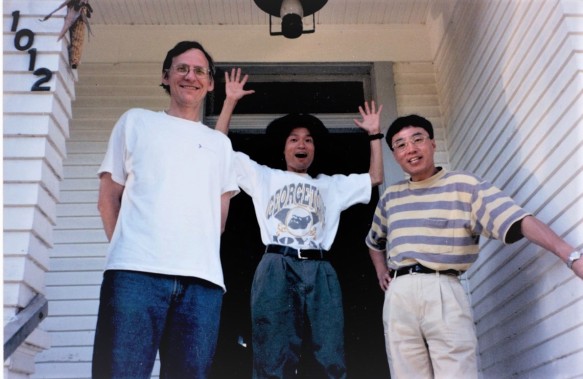
Denis Mair on Meng Lang

Three poets come to Bumbershoot

In honor of the passing of Meng Lang 孟浪 (1961 – 2018) on December 12 in Hong Kong, Cha: An Asian Literary Journal has published a commemorative piece by Denis Mair, his friend and translator:

All these details are just the outer lineaments of Meng Lang’s life, but his true story—his true biography–lies in the trajectory of his poems. He was a poet who found his own unique path to write about the social, political realities of his country in the language of modern, avant-garde thought. As a poet he always faced political realities, never going down a rabbit hole of metaphysics or aestheticism, yet each poem demonstrates his powerful artistic sensibility. I reaped tremendous reward by translating over a hundred of his poems, and I am proud that he trusted me with his beautiful creations.

Later this month Cha will publish a feature on Meng Lang and his place in poetry, with poems by Meng translated by Mair, as well as poems by Hong Kong writers Tang Siu Wa 鄧小樺, Jacky Yuen 熒惑, Kwan Tin-Lam 關天林, and Liu Waitong 廖偉棠 remembering Meng–as translated by Jennifer Feeley, Nick Admussen, Eleanor Goodman, and Lucas Klein.

Click here for Mair’s commemoration.

Yang Jian Poetry Now Out from Tinfish

Susan Schultz’s Tinfish Press is now announcing the publication of Long River, poems by Yang Jian 杨键 translated by Ye Chun, Paul B. Roth, and Gillian Parrish.

Longtime factory-worker and Buddhist practitioner, Yang Jian is considered by Chinese poets and public alike to be one of China’s most influential contemporary poets. This sustained recognition reflects his work’s power in communicating the loss and confusion felt by many Chinese living through a time of breakneck change. With haunting, plain-spoken lines and resonant images, Yang Jian’s poems skillfully combine simplicity and fullness—an aesthetic formed by a Taoist-Confucian commitment to balance as well as his Buddhist practices of awareness. This contemplative stance shapes a clear-eyed poetry with the depth of vision needed to articulate the personal suffering implicit in ideas of progress driving immense cultural and ecological devastations.

Click here to see what David Hinton, Steve Bradbury, and David Perry have to say about the book–and to order.

Paper Republic Roll-call of Book Translations from Chinese in 2018

Paper Republic has published its roll-call of book translations from Chinese into English in 2018.

We say this every year, but this really is a bumper crop. From classics to contemporary literature, poetry to scifi to short stories and a beautiful graphic memoir … our list this year has thirty novels or other book-length works, and six poetry collections.

The poetry books for 2018 are:

YANG Mu, Hawk of the Mind, ed. Michelle Yeh, various translators, (Columbia University Press)

Li Shangyin, ed. Chloe Garcia Roberts, tr. Chloe Garcia Roberts, A.C. Graham and Lucas Klein,  (New York Review Books)

GAO Xingjian, Wandering Mind and Metaphysical Thoughts, tr. Gilbert C F Fong. Bilingual edition (Chinese University Press)  

YAN Jun, 100 Poems of 10,000 Elephants, tr. Matt Turner and Weng Haiying (www.subjam.org)

MANG Ke, October Dedications, tr. Lucas Klein, Huang Yibing, and Jonathan Stalling (Zephyr Press)

ZHU Zhu, The Wild Great Wall, tr. Dong Li (Phoneme Media)

Take a look at the full list!


New Klein Translation / Translation Studies Publications

Mail to Hong Kong from North America can be slow, so even though the current issue of Metamorphoses, a double issue on literature in Chinese, guest-edited by Sujane Wu, has been on the stands for some weeks, I only received my copy today.

The issue includes two new translations I’ve done of poessays 诗文 by Xi Chuan, “On Fan Kuan’s Monumental Landscape Scroll Travelers among Mountains and Streams” 题范宽巨障山水《溪山行旅图》 and “Once More on Fan Kuan’s Travelers among Mountains and Streams” 再题范宽《溪山行旅图》.

It also includes a short essay titled “Our Daily Bread“:

Chinese steamed buns, or mantou 饅頭 “are, indeed, just bread.” The statement is by Harvard professor of medieval Chinese literature Stephen Owen, elaborating on his earlier comments on world literature, where he had said that in the“international poetry” he was looking at, “most of these poems translate themselves.” Is mantou just bread? And what does this assertion have to do with translation?


From there, I go on to discuss Walter Benjamin on pain and Brot, and Eliot Weinberger on pumpernickel and Wonder Bread (and steamed buns). Of all the articles of mine that have been published, this is probably my favorite.

Take a look!


Forty Years of TODAY: Poetry Reading & Book Launch

Poets & Speakers:
Bei Dao, Mang Ke, Xu Xiao, Huang Rui, E Fuming, Wan Zhi, Gu Xiaoyang, Song Lin, Chen Dongdong, Han Dong, Zhu Wen, A Yi, Liu Wai-tong, Yang Qingxiang, Xiao Haisheng, Tian Shui

Musicians: Zhou Yunpeng, Zhong Lifeng

Date: 23 December 2018
Time: 16:00-19:00
Address: 1/F, T. T. Tsui Building, University Museum and Art Gallery, The University of Hong Kong, 90 Bonham Road, Pokfulam, Hong Kong
Language: Putonghua

Visual Director: Ann Mak
Music Director: Dickson Dee

Organizer: TODAY
Co-organizers: University Museum and Art Gallery, The University of Hong Kong | Hong Kong Poetry Festival Foundation | Oxford University Press

2018年12月23日爲《今天》創刊紀念日,世界各地的《今天》作者、編輯將於香港共赴一場交換文學記憶的聚會,分享《今天》四十年來的歷程與思考。新舊《今天》的同仁或素昧平生,或多年來僅靠郵件溝通,有些人甚至從未晤面。這次既是一次重逢,也是一次相遇的機會。《今天》現誠邀讀者前來相聚,共同見證這份文學雜誌踏入下一個十年的啟航。

日期:2018年12月23日 (星期日)
時間:16:00-19:00
地點:香港薄扶林般咸道90號 香港大學美術博物館徐展堂樓1樓
語言:普通話 This activity will be conducted in Putonghua
費用:費用全免,無需報名,歡迎各界人士參與。Free admission. No registration required. All are welcome.
朗誦及發言嘉賓(排名不分先後):北島、芒克、徐曉、黃銳、鄂復明、萬之、顧曉陽、宋琳、陳東東、韓東、朱文、阿乙、廖偉棠、楊慶祥、肖海生、天水
特邀音樂人:周雲蓬、鐘立風
音樂總監:李勁松
視覺總監:麥安
主辦:《今天》雜誌
協辦:香港大學美術博物館、香港詩歌節基金會、牛津大學出版社

Daryl Lim on Yeh’s Yang Mu at Cha

Over at Cha, Daryl Lim reviews Hawk of the Mind: Collected Poems (Columbia University Press), the selected poems of Yang Mu 楊牧, edited by Michelle Yeh. Though Lim credits Yang’s poetry as “lyrical, urbane, cosmopolitan and deeply humanist,” he’s less impressed with the volume:

We are not told whether Collected in fact represents Yang Mu’s entire poetic oeuvre, or whether the editor has made selections. If so (which I suspect to be the case), it is also unclear how the editor went about making these choices or what organising principle lies behind them. I gather the poems are arranged chronologically. (But I can’t be sure.) Finally, the foreword tells me that I, the reader, will through engagement with Yang Mu’s poetry, “emerge more aware of the world and what it means to be human.” As it is though, I am still unaware of the shape of Yang Mu’s poetic corpus and career.

As for the translations,

No less than eleven translators are listed in the final pages of the book … I wish then that the editor, Michelle Yeh, had also written about the possible issues arising from this: did she consider whether having eleven translators for the work of one poet might lead to issues of coherence or dissonance? Did she consider re-translating (she is one of the translators) some of the poems? Did she edit any of the translations? Without the benefit of the original texts on the facing page (or even the original Chinese titles), it is difficult for the reviewer to judge whether the diversity of translators has had any effect on the final product. It is very difficult to look up specific poems. (There is also no index of poems or first lines.)

Not that Lim names them, of course (other than Arthur Sze, in one example). Then again, neither does Columbia UP on its web page for the book.

Click here for the full review.

Meng Lang, 1961 – 2018

Shanghai-born poet Meng Lang 孟浪, co-founder of Independent Chinese PEN, passed away following a battle with cancer on December 12 in Hong Kong.

The New York Times has run an article on his life, mentioning a few friends of this blog:

Meng Lang was born in Shanghai in 1961 and participated in several unofficial poetry movements in China throughout the 1980s, according a short biographical sketch published by Cha: An Asian Literary Journal, where Ms. [Tammy] Ho is a founding editor.

He later helped edit the book “A Compendium of Modern Chinese Poerty, 1986-1988,” and was a writer in residence at Brown University from 1995 to 1998, according to the sketch. Professor Huang [Yibing] of Connecticut College said that Mr. Meng moved to Hong Kong from the United States in 2006, and to Taiwan in 2015.

Mr. Meng “played an important, fearless role in championing an unorthodox, experimental and free-spirited poetry in China back in the 1980s,” Professor Huang, who is also a poet, said in an email.

The article also quotes lines from a poem of Meng’s, as translated by Anne Henochowicz:

Broadcast the death of a nation
Broadcast the death of a country
Hallelujah, only he is coming back to life.
Who stopped his resurrection
This nation has no murderer
This country has no bloodstain.

An article in Radio Free Asia also provides context on his life and works:

He had also managed an Archive of Chinese Underground Literature and Exile Literature after moving to the democratic island of Taiwan.

According to Taiwan poet Hung Hung, Meng always felt he was in exile after moving to Taiwan and Hong Kong to live with his Taiwan-born wife, Tu Chia-chi [杜家祁].

“He would say that it’s hard for trees to uproot and move somewhere else, and that he was forced into exile as a Chinese,” Hung Hung [鴻鴻] said. “This exile was thrust upon him, and it was particularly hard for him.”

“His last poem, about a fallen leaf finally blowing back home, is very beautiful and moving,” Hung said. “I think now he has passed away, the fallen leaf has finally returned home.”

Nick Admussen tweeted with links to more of his poems in English translation.

There has been an outpouring of affection and remembrances of Meng Lang on his Facebook page, and there is a reading in his memory in Hong Kong tomorrow night (Tuesday, December 18).

Alexander Dickow on Li Shangyin and Mang Ke

The new issue of Plume is here, and with it Alexander Dickow’s “Mystery and Surprise: Two Chinese Poets,” reviewing two quite different books of Chinese poetry in translation: Li Shangyin 李商隱, translated by Chloe Garcia Roberts, Lucas Klein, and A.C. Graham (NYRB), and October Dedications, the selected poetry of Mang Ke 芒克, translated by Lucas Klein with Yibing Huang and Jonathan Stalling (Zephyr / Chinese UP).

The review begins:

The contemporary Chinese poet Mang Ke and the Tang dynasty poet Li Shangyin (9th century) could hardly be more different. The former, particularly in the later poems of the chronologically arranged collection, seems fresh and spontaneous, capricious; the latter hermetic and mysterious. The contrast lends itself to an examination of what makes both poets’ work alluring. Li Shangyin seems to offer the mystique of an authentically coded poetic language. While both Mang Ke and Li Shangyin are highly allusive, Mang Ke feels bright and sensuous, Li Shangyin dark and richly layered.

It’s rare enough for translated poetry to be reviewed at all, but when it is reviewed it tends to be reviewed by other experts in the field. I think it’s wonderful that these books are reviewed by a translator of French poetry with no expertise in China or Chinese literature. If our readers are only those who can check our work, what’s the point of translating in the first place? The whole purpose of translation is bringing work from one language to new audiences, so it’s wonderful that Plume went with a reviewer who doesn’t need to know Chinese, but clearly understands poetry and translation.

Click here to read the review in full.

Stephen Owen and Yoshinobu Shiba Tang Prize Video

A video honoring Stephen Owen and Yoshinobu Shiba 斯波義信 for their 2018 Tang Prizes for Sinology; in Chinese with interviews in English and Japanese.

The first half of the video focuses on Owen, and includes interviews with Mai Huijun 麦慧君, Tina Lu, Luke Bender, Kang-i Sun Chang 孫康宜, Peter Bol, Xiaofei Tian 田曉菲, and Owen himself.

The background music is sentimental and too loud, but ignore it if possible.