Review of Push Open the Window

Over at The Rumpus, Christopher Honey has a review of Push Open the Window: Contemporary Poetry from China. It’s not a perfect review, in my mind–he doesn’t acknowledge the translators by name–but he does raise some interesting issues and questions. Here are a few I found worth considering (which is not to say agreeing with):

From my own personal experience, I always wonder who I am reading when I read Rexroth’s beautiful collections of Asian poetry in translation. Am I reading Tu Fu or am I actually reading Rexroth?
…
The quality and sophistication of the poets seems to go up as the poets get younger and younger. The earliest poets have a sort of untutored enthusiasm – almost like naïve art – touched by the political.
…
I do not believe I am going out on a limb by saying that the more recent poets in Push Open the Window are much more fully connected to the larger literary world. As barriers to the rest of the world have dropped, poets have benefitted by cross pollination with other traditions.
…
The number of translators also led to another potential issue. A single translator would have enabled a more accurate understanding of the development and changes within Chinese poetry over the last fifty years. With so many different translators, how can one be sure that a perceived, new rhetorical addition to the bag of tricks available to Chinese poets isn’t just a tic of one translator as opposed to another?
…
It is hard to escape seeing it a sort of historical or sociological document on the evolution of literary schema rather than as a work of literature. What is more, with the variations in the quality of the poems, I find it hard to believe that historical thinking was not a factor in the selection process – that this book was intended to document the progress of literary evolution and not just to provide the best literary products.

Fourth Anniversary Issue of Cha

The fourth anniversary issue of Cha: An Asian Literary Journal is now live. In addition to the quality poetry, fiction, & non-fiction, this issue also features new sections such as a Supplement on publishing in Hongkong, Singapore, Malaysia, and Macau. The book review section is also worth noting, especially for its take on Amblings, the new selected poems of Leung Ping-Kwan 梁秉鈞.

I’ll be guest-editing Cha‘s “Ancient Asia Issue,” scheduled to launch August 2013. See also their earlier publication of my translation of five sections from Xi Chuan’s “Thirty Historical Reflections” 鉴史三十章 from their China Issue.

Words & the World in the stores

Words & the World, the multilingual anthology and twenty-volume box-set of the International Poetry Nights, is now in stores, as I noticed when in a bookstore in Tsim Sha Tsui 尖沙咀. Right before snapping this picture, I saw a browser stop by the display, read a few lines, and head off to buy one of the pocket editions. No joke!

If you’re not in the Hongkong area or can’t find these books in a shop near you, click on the image to get to the ordering page.

Caging a Monster

Xi Chuan discussed the state of publishing in China and read his co-translations of Norwegian poet Olav H. Hauge with Harald Bøckman during Chinese Literature Week at Norway’s Litteraturehuset–with “around 4,000 attendees at 30-some events,” according to Paper Republic‘s Eric Abrahamsen–but what seems to have been the most newsworthy event was the talk by Murong Xuecun 慕容雪村 titled “Caging a Monster” 把野兽关进笼子 (translated by Jane Weizhen Pan & Martin Merz). In light of Xi Chuan’s notion of his poetics as based on contemporary China’s oxymoronism, I cite the following quotation from Murong’s speech:

My country is capable of launching a satellite into space but not of building a safe bridge across a river. My country is capable of building palatial government offices yet condemns children to substandard schoolhouses. My country provides millions of luxury cars to government official yet few safe school buses for children.

这个国家可以把卫星送入太空,却造不好一座桥。这个国家可以把政府大楼造成金碧辉煌的宫殿,却让孩子们坐在摇摇欲倒的危房之中。这个国家有无数豪华的行政座驾,却没有一辆坚固的校车。

Chinese Names in Push Open the Window

When I first wrote about the Copper Canyon anthology Push Open the Window, I said, “My only quibble with the book so far is that, while everything is printed with Chinese and English en face, for some reason the Chinese characters of none of the poets’ names made it into the book.” Co-translation editor Sylvia Lin has worked to address this, writing in a recent post to the Modern Chinese Literature & Culture email list:

List members may be interested in a new bilingual anthology of contemporary Chinese poetry, Push Open the Window, the third volume in a larger project of bilingual anthologies of contemporary poetry funded by the NEA. The poems were selected by the Chinese editor, Qingping Wang, with Sylvia Li-chun Lin and Howard Goldblatt as translation editors.

Despite our objections, the publisher, Copper Canyon Press, chose not to include the poets’ names in Chinese. We are making them available here; feel free to share the list with other users of the anthology.

Shi Zhi 食指
Mang Ke 芒克
Shu Ting 舒婷
Yu Jian 于坚
Zhai Yongming 翟永明
Wang Xiaoni 王小妮
Sun Wenbo 孙文波
Gu Cheng 顾城
Bai Hua 柏桦
Zhang Shuguang 张曙光
Wang Jiaxin 王家新
Song Lin 宋琳
Xiao Kaiyu 肖开愚
Han Dong 韩东
Chen Dongdong 陈东东
Zhang Zao 张枣
Qing Ping 清平
Sen Zi 森子
Huang Canran 黄灿然
Xi Chuan 西川
Huang Fan 黄梵
Cai Tianxin 蔡天新
Zang Di 臧棣
Hai Zi 海子
Ye Hui 叶辉
Ma Yongbo 马永波
Shu Cai 树才
Yi Sha 伊沙
Yu Nu 余怒
Ge Mai 戈麦
Lan Lan 蓝蓝
Xi Du 西渡
Yang Jian 杨键
Sang Ke 桑克
Chen Xianfa 陈先发
Lin Mu 林木
Zhou Zan 周瓒
Zhu Zhu 朱朱
Jiang Tao 姜涛
Yan Wo 燕窝
Jiang Hao 蒋浩
Ma Hua 马骅
Han Bo 韩博
Leng Shuang 冷霜
Duo Yu 朵渔
Hu Xudong 胡续冬
Qin Xiaoyu 秦晓宇
Shen Muqin 沈木槿*
Wang Ao 王敖

* The book prints this name as Shen Mujin; the character can be pronounced either jǐn or qín.

Making the Translator Visible

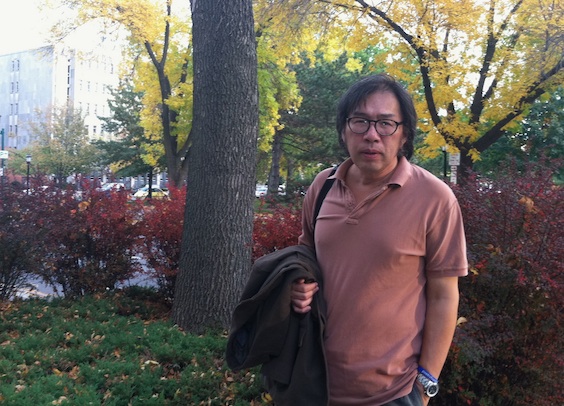
When Three Percent announced they’d be re-running their Making the Translator Visible series, I knew it was only a matter of time before they got to me, questionable picture and all. Well, here it is, along with an amusing story about some of the obstacles on the way to visibility.

I should note, also, in praise, that it’s standard New Directions practice to list the translator’s name on the cover page of their books.

BBC: When borrowing from China makes the US richer

When Xi Chuan and Zhou Zan were on their reading tour of the US promoting the Copper Canyon anthology Push Open the Window, the BBC caught up with them and interviewed them about Chinese poetry. On the 3rd of November they posted the article and video, titled “When borrowing from China makes the US richer.”

While I’m all for contextualizing poetry in terms of international politics and economics–writing, after all, is about something, and it often refers, in its oblique ways, to current global realities–I have to say I found the BBC report pretty lame. The article’s brushstrokes are obstinately broad, saying nothing more nuanced than “China holds trillions of dollars in US debt and the eurozone countries are looking to Beijing for bailout cash, but not all international transactions come at a price. A cultural exchange is also under way between east and west.”

Meanwhile, the accompanying video–which, unfortunately, I cannot embed into this post–hits the only two notes about China the BBC expects will resonate with English-speakers: it starts out talking about censorship, and ends up talking about classical Chinese poetry as calligraphy pans by and a reed flute lulls in the background. To be clear, Xi Chuan’s writing engages with the classics of Chinese poetry in fascinating and unexpected ways, and as a teacher of ancient Chinese literature and former calligrapher, Xi Chuan enjoyed the chance to get a private tour of the Freer Gallery and some of the pieces not normally on display. But rather than exhibit how Xi Chuan draws on the Chinese tradition, the BBC video suggests he’s an Ancient Poet (albeit one who has to deal with Maoist censorship)! When Xi Chuan reads from my translation of “Exercises in Thought” 思想练习 (a poem that opens with a demand that we reevaluate Nietzsche) Chinese chamber music kicks in and the accompanying image is a scroll of calligraphy–as if that were the text of the poem!

Art Talk with Xi Chuan

On the first of November the National Endowment for the Arts posted an interview between Xi Chuan and Katie Schulze, conducted in English over email while Xi Chuan was on a reading tour in the US promoting Push Open the Window (the NEA partly funded the anthology, as part of its five-year literature translation initiative). Xi Chuan’s answers again demonstrate the breadth and depth of his poetic mind. Here’s perhaps my favorite moment:

NEA: Which one of your poems is the most significant to you—in terms of subject, or the evolution or your work, or some other criteria?

XI CHUAN: A series named “Salute,” finished in 1992. 1989 abolished my method of writing poetry. Prior to 1989 I had many model poets that I tried to follow. Later, I found that these models were not enough for me to express myself. I almost stopped writing between 1989 and 1992; there was a crash in my heart, so I started writing notes. In 1992, I wrote “Salute” and it started with notes to vomit emotions/experiences about dark things that happened between 1989-1992. After I wrote this poem, I changed absolutely. Before I had an “I” in my heart; later I found [that it was multiple] “I’s” and not “we.” I found that all these deceased people live in my heart.

ALTA Conference 2011

The annual conference of the American Literary Translators Association is going on now, in Kansas City, MO. Here’s a video from incoming president and translator of Spanish poetry, Gary Racz:

The ALTA conference is reliably one of the best annual conferences there is, and I’m sad that distance and time have conspired to keep me away. This year’s panels, lectures, and readings look as enticing as ever (as I wrote about the ’08 conference in St. Paul, “People actually want to go to panels at ALTA”), so if you’re near KC, I recommend stopping by. And if you’re a literary translator who’s not a member, I recommend joining.

For updates of this year’s conference, keep an eye on Chad Post’s posts on Three Percent, which is also re-running the Making the Translator Visible series of pictures and Q&As from ’09.