Lilburn on Xi Chuan & Zhai Yongming in Brick

The Canadian literary journal Brick has published Tim Lilburn’s essay on “A Mandelstamian Generation in China,” on Xi Chuan and Zhai Yongming 翟永明. He writes,

There has been a tendency in North America and Europe to imagine Chinese writers, poets especially perhaps, as inevitably and necessarily political, dissidents in a way that flatters the West. This was true for writers in the Soviet Union too, which made it difficult, for example, to appreciate the complete range of someone like Joseph Brodsky once he first became known outside of Russia. Taking Xi Chuan this way, or any in his generation, would bring on similar reductive distortions. It is true that in China’s current state of cultural undefinition, some intellectuals, as Xi Chuan told [Eleanor] Wachtel, “are trying to rethink or reflect on history, not only ancient history but also on modern history, revolutionary history,” in order to imagine a possible, more coherent China. It’s also true that traditionally poets, like scholars, in the Confucian scheme of things, have seen themselves as serving the state by helping to shape its notion of itself, either by speaking directly to the masses or by educating the ruler. But the West is chiefly keen to identify dissidents wherever it can, because these, it supposes, are warriors for its own cause within an opposing power, who work utterly at their own risk. It’s hard to believe that any of the major Chinese poets I spoke to seeks to fulfill the role of furthering Western cultural expansion. As Xi Chuan said in the Wachtel interview: “I don’t think Cnia will one day become, for instance, Canada, America, England, or France.” Nor, it seems, does he wish exactly that it would. When I asked the Chinese poets gathered in 2008 at White Stone Town in Anhui Province how they thought of being seen by the West as dissidents, Ouyang Jianghe, one of the most fiery of the group, exploded that he had no wish to be regarded as a writer who was professionally a disaffected Chinese intellectual. Such a vocation was far too soft and besides was a self-serving invention from elsewhere.

For ordering information and the journal’s table of contents, click the image above.

Almost Island Dialogues

Almost Island is a space for literature that threatens, confronts, or bypasses the marketplace. The space began with an online journal, then expanded to an international writers dialogue, held every year. The seventh edition of the Almost Island Dialogues will be held at the India International Centre, New Delhi, from December 19th to 22nd, 2013.
The discussions centre on issues of craft, form, and content as well as the context of writing in different cultures. Unlike a literary festival, Almost Island likes to keep the Dialogues small, rigorous, and intimate. These conversations are concerned with process, with how things are learnt, explored, created, and created again. This year we plan to continue with some singular writers. The mornings and afternoons are kept for intense, extended, freewheeling talks and discussions; the evenings, for readings and performances.
The readings are open to all, but to attend the day discussions pre-registration is needed. For pre-registration and any other queries, please write to Rahul Soni at almostisland.edit@gmail.com.

SCHEDULE
Evening Readings / Performances on the IIC Annexe Lawns (All Are Welcome.)

Thursday, December 19, 6:30 pm
Baha’ud-din Dagar

Friday, December 20, 10.30 am to 1 pm and 2.30 pm to 5 pm László Krasznahorkai / Xi Chuan

Saturday, December 21, 10.30 am to 1 pm Ashis Nandy / Baha ud-din Dagar

Sunday, December 22, 10.30 am to 1 pm and 2.30 pm to 5 pm Arvind Krishna Mehrotra / Renee Gladman

Panels and Discussion at Conference Room 1, IIC Main Centre (NB: panels are also open to all who wish to come, but

pre-registration is required. Contact Rahul Soni at
almostisland.edit@gmail.com for more details.)

Friday, December 20, 10.30 am to 1 pm and 2.30 pm to 5 pm
László Krasznahorkai / Xi Chuan

Saturday, December 21, 10.30 am to 1 pm
Ashis Nandy / Baha ud-din Dagar

Sunday, December 22, 10.30 am to 1 pm and 2.30 pm to 5pm
Arvind Krishna Mehrotra / Renee Gladman

Download the .pdf for more information.

Announcing the Ancient Asia issue of Cha

Announcing the Ancient Asia Issue of Cha (December 2013), featuring new translations of Chinese poetry by Xi Chuan, Tao Yuanming 陶淵明, Du Fu 杜甫, He Qifang 何其芳, Xiao Kaiyu 肖开愚, Liu Yong 柳永, the Shijing 詩經, Laozi 老子, Du Mu 杜牧, and Li Shangyin 李商隱, and new work by Eliot Weinberger, Matthew Turner, Eleanor Goodman, Sharmistha Mohanty, and Jonathan Stalling. The full list of contributors:

Translation: Lucas Klein, A.K. Ramanjuan, Reid Mitchell, George Life, Canaan Morse, Michael Gray, Christopher Lupke, Dulal Al Monsur, Nicholas Francis, Michael Farman, Michael O’Hara, Eleanor Goodman, Chloe Garcia Roberts

Poetry: Eliot Weinberger, Matthew Turner, W.F. Lantry, Aditi Rao, Stuart Christie, Luca L., Xiao Pinpin, Kate Rogers, Pey Pey Oh, DeWitt Clinton, Elizabeth Schultz, Stephanie V Sears, Joshua Burns, James Shea, Sean Prentiss, Steven Schroeder, Marjorie Evasco, Arjun Rajendran, Pui Ying Wong, Julia Gordon-Bramer, June Nandy, Janice Ko Luo, Stuart Greenhouse, Barbara Boches, Cathy Bryant, Justin Hill, Eleanor Goodman

Fiction: John Givens,  Xie Shi Min, Sharmistha Mohanty, Zhou Tingfeng, Khanh Ha

Articles: Jonathan Stalling, Michael Tsang

Creative non-fiction: Pavle Radonic

Photography & art: Alvin Pang (cover artist), Adam Aitken

Click the image above to access the full issue.

Susan Gillis’s When the City Goes Dark: Xi Chuan’s “Power Outage”

Recently in conversation Phil Hall pointed to a source of continuing interest in lyric poetry: that the personal is political. This poem reminds me the reverse is also true.

There’s no happy discovery at the end of Xi Chuan’s “Power Outage” such as there is in my sentimental framing of the ice storm stories. When the power goes out, the poem-speaker is cast into a disordered state. The darkness reveals small sounds far and near, traces of human presence in “wind chimes and a cat’s footbeats,” an engine that stops and a song that goes on. Loneliness and isolation are almost palpable.

Then “time turns back,” and darkness takes on a deeper tone, as living crows converge around a plate of crow meat, and blackness engulfs the poem’s speaker entirely. Despair acquires an odour and a name: power outage. The poem-speaker is pitched into an impossible, subsuming blackness. All he can do is summon a frustrated mutter as he recognizes his own wordless shadow.

Click the image above for the whole piece, & for more of Gillis’s writings on contemporary poetry.

Former People Interview with Lucas Klein on China and Literary Modernism

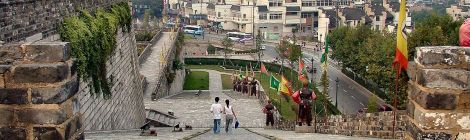
1280px-2004_0928_Nanjing_ZhongHuaGate_HorseRamp2C. Derick Varn of Former People: A Journal of Bangs and Whimpers interviewed me with a series of complex questions on modernity and modernism in and about China. And of course, I couldn’t resist talking about Xi Chuan and Chinese and international poetry. Here’s an excerpt:

So that’s the problem. But as I’ve argued in a piece that’s forthcoming, modernism in literature is postmodernist in its philosophical implications … And I don’t think I’ve ever believed in modernism so much as modernisms. An interesting observation is that modernist writers who come from countries that claim an ownership of tradition—modernists from France or Italy or Russia—are often the ones to say, like Marinetti, “Museums, cemeteries!” while the modernists from countries that cannot claim such ownership—Pound and Eliot from the US, Joyce from Ireland—are the ones who want to revivify the ancient amidst the machinations of the modern (this isn’t foolproof, of course: William Carlos Williams and Gertrude Stein stand against such generalizations). As for whether there’s a Chinese modernism, the interesting thing is that after the Cultural Revolution, you get both: those feeling like their country has too much a claim on tradition, and is overwhelmed and stifled by it, as well as those who feel like their country is too displaced from tradition, and needs to re-own it and re-define it. So at any given moment Bei Dao might read like a shrugging off of tradition, and Yang Lian might read like a refitting of it, and Xi Chuan a refitting of that refitting, but they’re also specific responses to the relationship between tradition and modernity as have played out in China in the past hundred years and more.

Click the image above for the full feature.

Sinica: Chinese Literature in Translation podcast

At Popup Chinese Jeremy Goldkorn interviews translators Linda Jaivin and Alice Liu for a wide-ranging translation of what translation is, how it affects us, how to or not to do it, and how contentious translators can be in private. All that and a resounding endorsement of Xi Chuan’s Notes on the Mosquito!

Listen here or follow this link to download.

Audio clip: Adobe Flash Player (version 9 or above) is required to play this audio clip. Download the latest version here. You also need to have JavaScript enabled in your browser.

Xi Chuan, Yu Hua, Mo Yan, & others at Istanbul Book Fair

China will be guest of honor at the International Istanbul Book Fair (Nov 2-10), with the theme being the Journey of Chinese literature from traditional to contemporary as illustrated by the “New Silk Road.”

Festivities are scheduled to include Xi Chuan 西川 and sixteen other Chinese authors, such as Ge Fei 葛菲, Jiang Nan 江南, Lao Ma 马俊杰, Li Jingze 李敬泽, Liu Zhenyun 刘震云,  Su tong 苏童,  Wang Gang 王刚, Yang Hongying 杨红樱, Yu Hua 余华, Zhang Wei 张炜,  Zhang Yueran 张悦然, and China Writers Association president, Tie Ning 铁凝.

For more, click the image above, or see here.

Notes on the Mosquito awarded Lucien Stryk Prize

The 2013 Lucien Stryk Prize went to Lucas Klein for his translation of the Chinese poetry collection Notes on the Mosquito by Xi Chuan. The $5,000 prize, which was established by an anonymous donor, recognizes the best book-length translation into English of Asian poetry or of source texts from Zen Buddhism.

…

“Klein’s volume is the most deserving of the prize by virtue of the quality of many of the translations and the caliber of the poems they represent,” said the Stryk Prize committee. “Judging from this collection, Xi Chuan is clearly a major poetic voice whose formal versatility and relentlessly unswerving insights into the often grim but fascinating here and now of China’s comédie humaine represent a significant contribution to Chinese letters and are well-deserving of a Western readership.”

Tinfish Press of the Month at SPD

Tinfish Press

Tinfish Press, which published the Xi Chuan chapbook Yours Truly & Other Poems, is Press of the Month at Small Press Distribution. Click the image for 40% Off Selected Titles and more information.

More on Tinfish:

Tinfish Press publishes experimental poetry from the Pacific Region.

Tinfish has been called “one of the great small presses of the United States” (Ron Silliman). Hank Lazer notes that “Tinfish Press most definitely increases a reader’s sense of the highly specific, highly localized terms of composition.” Marie Carvalho writes that Tinfish “vibes on [a] irreverent cross-cultural mix of language, vision, viewpoint and design.”

Founded in 1995, Tinfish published 20 issues of a journal (now discontinued), as well as numerous chapbooks and full length collections. Their mission has been to inspire conversations between a diverse, far-flung group of writers.

Tinfish is particularly interested in language issues in Hawai`i and the Pacific and has published books in and including Pidgin (Hawaiian Creole English), Samoan, Tagalog, Hawaiian, and Chamorro. While Tinfish does not publish writers for their ethnic or gender identities, they have been leaders in publishing experimental work by Asian Americans, Pacific Islanders, native Hawaiians, Euro-Americans from Hawai`i and others.

Poetry on Fire: Xi Chuan & Helen Wing at M Restaurant Beijing

Sunday, August 25, 4 p.m.
RMB 75, includes one drink


Poets Helen Wing and Xi Chuan come together to explore the idea of poetry as fire, from the fire imagery in their poems to their views on how the poetic imagination spreads, like fire, beyond borders. Writing in English (Helen) and Chinese (Xi Chuan), their work suggests that (with apologies to Robert Frost) poetry is not, after all, lost in translation.

The event promises to be excellent (I’ve hated Robert Frost for that line long enough, but now it’s time people were aware that David Bellos has demonstrated that “nobody has ever been able to find Frost saying anything like it in his works”). And here’s Helen Wing’s bio:

Helen Wing is a poet and a fiction writer who lives variously in Beijing, Cairo and London.  Currently she is Writer-in-Residence at Harrow International School, Beijing and works part-time at Renmin Da Xue. At Harrow, she promotes poetry writing with the students and publishes an annual poetry book project, done jointly with Harrow students and the students at Project Hope Vocational School, a migrant children’s charity school based in Wangjing.  Her poetic work, Archangel, rose to number four on Amazon’s e-kindle poetry list last year. Other poems have been published in a recent Middle Eastern anthology, Nowhere Near a Damned Rainbow: Unsanctioned Writing of the Middle East. Her stories have been published in the Mississippi Prize Review, the Southern Cross Review, in the Tale of Four Cities and Sukoon. She is currently working on a novel called I swore I’d set that donkey free before I left Beijing.

Born in London, Helen studied Spanish and French at Cambridge University and holds a PhD in Spanish poetry.