Making the Translator Visible

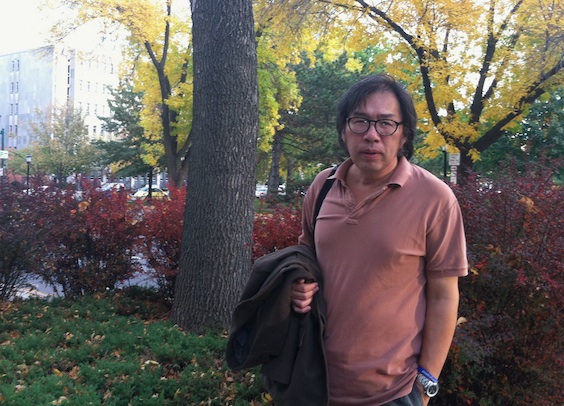
When Three Percent announced they’d be re-running their Making the Translator Visible series, I knew it was only a matter of time before they got to me, questionable picture and all. Well, here it is, along with an amusing story about some of the obstacles on the way to visibility.

I should note, also, in praise, that it’s standard New Directions practice to list the translator’s name on the cover page of their books.

BBC: When borrowing from China makes the US richer

When Xi Chuan and Zhou Zan were on their reading tour of the US promoting the Copper Canyon anthology Push Open the Window, the BBC caught up with them and interviewed them about Chinese poetry. On the 3rd of November they posted the article and video, titled “When borrowing from China makes the US richer.”

While I’m all for contextualizing poetry in terms of international politics and economics–writing, after all, is about something, and it often refers, in its oblique ways, to current global realities–I have to say I found the BBC report pretty lame. The article’s brushstrokes are obstinately broad, saying nothing more nuanced than “China holds trillions of dollars in US debt and the eurozone countries are looking to Beijing for bailout cash, but not all international transactions come at a price. A cultural exchange is also under way between east and west.”

Meanwhile, the accompanying video–which, unfortunately, I cannot embed into this post–hits the only two notes about China the BBC expects will resonate with English-speakers: it starts out talking about censorship, and ends up talking about classical Chinese poetry as calligraphy pans by and a reed flute lulls in the background. To be clear, Xi Chuan’s writing engages with the classics of Chinese poetry in fascinating and unexpected ways, and as a teacher of ancient Chinese literature and former calligrapher, Xi Chuan enjoyed the chance to get a private tour of the Freer Gallery and some of the pieces not normally on display. But rather than exhibit how Xi Chuan draws on the Chinese tradition, the BBC video suggests he’s an Ancient Poet (albeit one who has to deal with Maoist censorship)! When Xi Chuan reads from my translation of “Exercises in Thought” 思想练习 (a poem that opens with a demand that we reevaluate Nietzsche) Chinese chamber music kicks in and the accompanying image is a scroll of calligraphy–as if that were the text of the poem!

Art Talk with Xi Chuan

On the first of November the National Endowment for the Arts posted an interview between Xi Chuan and Katie Schulze, conducted in English over email while Xi Chuan was on a reading tour in the US promoting Push Open the Window (the NEA partly funded the anthology, as part of its five-year literature translation initiative). Xi Chuan’s answers again demonstrate the breadth and depth of his poetic mind. Here’s perhaps my favorite moment:

NEA: Which one of your poems is the most significant to you—in terms of subject, or the evolution or your work, or some other criteria?

XI CHUAN: A series named “Salute,” finished in 1992. 1989 abolished my method of writing poetry. Prior to 1989 I had many model poets that I tried to follow. Later, I found that these models were not enough for me to express myself. I almost stopped writing between 1989 and 1992; there was a crash in my heart, so I started writing notes. In 1992, I wrote “Salute” and it started with notes to vomit emotions/experiences about dark things that happened between 1989-1992. After I wrote this poem, I changed absolutely. Before I had an “I” in my heart; later I found [that it was multiple] “I’s” and not “we.” I found that all these deceased people live in my heart.

ALTA Conference 2011

The annual conference of the American Literary Translators Association is going on now, in Kansas City, MO. Here’s a video from incoming president and translator of Spanish poetry, Gary Racz:

The ALTA conference is reliably one of the best annual conferences there is, and I’m sad that distance and time have conspired to keep me away. This year’s panels, lectures, and readings look as enticing as ever (as I wrote about the ’08 conference in St. Paul, “People actually want to go to panels at ALTA”), so if you’re near KC, I recommend stopping by. And if you’re a literary translator who’s not a member, I recommend joining.

For updates of this year’s conference, keep an eye on Chad Post’s posts on Three Percent, which is also re-running the Making the Translator Visible series of pictures and Q&As from ’09.

New Publication

The new issue of Plume is up, with excellent new pieces from the likes of Cole Swensen and Georg Trakl (translated by Mark Wunderlich). And Xi Chuan, in my translation of “The Ant’s Plunder” 蚂蚁劫 (according to Daniel Lawless’s Editor’s Note, their “first work from a Chinese poet”). Plume only publishes twelve pieces a month, so their dedication of space to Xi Chuan is all the more exciting.

Thanks to Steve Bradbury for pointing me to Plume!

Chinese Week at Norway’s Litteraturhuset

As I mentioned yesterday, Xi Chuan flew from Hongkong to Norway, where he’s participating in Chinese Literature week at the House of Literature along with Wang Hui 汪晖, Murong Xuecun 慕容雪村, Ma Jian 马建, Leslie T. Chang, Rebecca Karl, Michael Dutton, Yiyun Li 李翊雲, Hong Ying 虹影, Mian Mian 棉棉, Xu Zechen 徐则臣, Han Song 韩松, Lan Lan 蓝蓝, Annie Baobei 安妮宝贝, Cheng Yong Xin 程永新, Zou Zou 走走, and Paper Republic‘s Eric Abrahamsen. Click here for the full schedule; the following is the list of events involving Xi Chuan (though I’m afraid one looks like it’s already in the past):

MONDAY THE 14TH OF NOVEMBER
7.30pm: Putting a Modern Face on the Classics
Discussion with Xi Chuan and Cheng Yongxin

Traces of this classic literature are also still to be found in today’s contemporary Chinese literature. What is the relationship between the classics and today’s writers, and do the latter use them in their own literature? Xi Chuan and Cheng Yongxin discuss their relationship to classic literature.
Language: Norwegian (with translation from Chinese)

THURSDAY 17TH OF NOVEMBER
8pm: Chinese Contemporary Poetry
Glimpse of the World’s Oldest Poetry Tradition

Stage conversations with Lan Lan and Xi Chuan
From early times, poetry played a far greater role in China than it did in the West. Even under the Zhou dynasty, more than a thousand years before the Western Christian Era, important political statements were often phrased as verses of famous poems. What does contemporary poetry look like in a country with such a long poetic tradition? Harald Bøckman talk with two poets about their works and the current trends in modern Chinese poetry.
Language: Norwegian (with translation from Chinese)

FRIDAY THE 18TH OF NOVEMBER
10am-2pm: From China to the World and Back: Seminar on translation
Introduction by Anna Gustafsson Chen, Eric Abrahamsen, Xi Chuan, Harald Bøckman, Lars Devold and others
Translating between Chinese and European languages can prove to be a difficult task when the written languages present such different linguistic structures. In Europe, Chinese literature is often translated from earlier English translations, a practice which can lead to mistakes and inaccuracies. What are the challenges one faces while translating and interpreting between Indo-European languages and Chinese? We meet up with translators who tell us about their work.
Language: English

SATURDAY THE 19TH OF NOVEMBER
8pm: An Evening of Celebration!
Readings by Yiyun Li, Lan Lan, Murong Xuecun, Cheng Yongxin, Li Er, Xu Zechen, Mian Mian, Han Song and Xi Chuan
Welcome to our evening of celebration with eleven Chinese writers, book readings and a concert. We close this Chinese literature week at the House of Literature with literary and cultural experiences. Concert with Chinese folk musician Xiaogang Zeng and Rolf-Erik Nystrøm. Host: Anna Bache-Wiig
Language: Norwegian (with translation from Chinese)

International Poetry Nights Wrap-up

The final reading of the International Poetry Nights Hong Kong 2011 took place last night, with Paul Muldoon (Ireland / USA), Tian Yuan 田原 (China/Japan), and Yip Fai 葉煇 (Hong Kong) reading. Tian Yuan also read the poems of Japanese poet Shuntarô Tanikawa, who was prevented from traveling due to illness. And as with Xi Chuan’s graciousness on the first night’s reading, Tian Yuan extended thanks to his English translator, Denis Mair.

Though the Nights are over, and Xi Chuan has flown off to Norway (about which I’ll be posting anon), the conversation continues at Paper Republic, with notes by Canaan Morse and extra commentary by Yours Truly. Also, I expect that videos of the readings will be posted on YouTube, as they were two years ago, so expect clips and further links to those as they appear.

International Poetry Nights

The “Masters & (M)other Tongues” discussion at CUHK yesterday was fascinating, though not in the ways I had expected. I had thought that it would be a discussion about the tension between the two sides of the parenthesis around “(m)other tongues,” and about the models the poets use for their own work from traditions either native or foreign to them. But now that I look at the schedule online again I see that it’s simply “Masters & Mother Tongues,” which creates a different kind of tension; perhaps this accounts for the difference, since all the participants—Liu Wenfei 劉文飛 (the Chinese translator of Arkadii Dragomoshchenko, unable to attend due to  illness), Silke Scheuermann, Vivek Narayanan, and Xi Chuan—ended up discussing “mother tongues” amidst the troubling connotations of the word “master.” And they all ended up talking about their own sense of awkwardness and embarrassment. Xi Chuan, for instance, said that while people from other parts of China used to have to apologize for not speaking Mandarin well, he feels embarrassed about only speaking Mandarin, and only rarely speaking the related, but distinct, Beijing dialect.

The evening’s reading was excellent. Liu Wenfei read Dragomoschenko’s poems in Russian, followed by Ling Yu 零雨 (some of whose pieces I also translated), then C. D. Wright, and then Xi Chuan—with excellent zither 古琴 performances by Yao Gongbai 姚公白 interspersed. During Ling Yu’s reading she was mysteriously moved to tears by the memories her poems called up, which was stunning to witness, not least because my experience translating her work was to be filled with a very different sense of mystery. And Xi Chuan, always gracious, was the only of the poets reading to thank his translator—to which I can only say, my pleasure!

Above and below are two shots I took of Xi Chuan’s reading.

This afternoon at 3:30 at City University (Connie Fan Multi-media Conference Room, 4/F Cheng Yick Chi Building) I’ll be leading a discussion on “Writing Across Languages” with Bejan Matur (Turkey), Tomaž Šalamun (Slovenia), Tian Yuan 田原(China / Japan), and Yao Feng 姚風 (China / Macau). The readers this evening at 7:00 at the Lee Shau Kee School of Creativity (Multi-Media Theatre, 135 Junction Road, Kowloon) are Régis Bonvicino (Brazil), Lo Chih Cheng 羅智成 (Taiwan), Bejan Matur, and Yu Xiang 宇向 (China).

Xi Chuan in Hongkong

Last night the International Poetry Nights hosted a banquet dinner at the China Club, at the top of the old Bank of China building. Here’s a picture of me and Xi Chuan, with the new Bank of China Tower in the background:

Xi Chuan will be part of the panel discussion “Masters and (M)other Tongues,” moderated by Prof. Leo Ou-fan Lee, this afternoon at 3:30 at Chinese University of Hong Kong (Cho Yiu Conference Hall, G/F Administration Building), and reading tonight at 7:00 at the Lee Shau Kee School of Creativity (Multi-Media Theatre, 135 Junction Road, Kowloon) with Arkadii Dragomoshchenko, Ling Yu 零雨, and CD Wright.