Chinese Poetry in Translation Database Back Online

Zeb Raft’s Chinese Poetry in Translation database is back online!

The cover page explains:

This site is part of a project on the history of Chinese poetry in translation. The ultimate goal is to catalog existing translations as comprehensively as possible (primarily English, but with other languages added selectively). It is currently far from that, but translations from nearly forty diverse sources have been input, including the major anthologies regularly used in the classroom.

From the FAQ:

Q: What information will I find on this site?
A: You can browse and search for translations of various poems, poets and translators. Nearly forty sources have been input so far.

Q: Where are the poems?
A: At the library. Or, in some cases, on the internet. Some day we may be able to incorporate full-text poems here, but for now this is a finding list. Some of the sources can be found on Google Books, and most of the pre-1922 works are on www.archive.org. You can often find the Chinese texts by highlighting the Chinese title and doing a web search.

You can search by Poem Title (in pinyin or Chinese), Translation Title, Poet, Dynasty, Source Title, or Translator.

Have a look!

Chinese Poetry of the Cup?

As part of its Mingbai series (“a daily newsletter that drops knowledge on things ‘everyone in China knows, but almost nobody outside the country knows'”), SupChina has posted a feature on “Chinese poetry of the cup.”

First it introduces baijiu 白酒, “the Chinese king of liquors … made primarily with sorghum, although other bases like wheat and rice are often added to the mix.”

Then it asserts:

Some of China’s finest poets — perhaps even the finest — were admirers of the merry drink. Let’s take a look at Li Bai 李白, whose immortal poetry is learned by heart in every classroom across China … Li Bai lived during the Tang Dynasty (618-907), often known as China’s Golden Age. His poems were often about the beauty of friendship, the wonders of nature, and wine … One of Li Bai’s poems, “Drinking Alone Under the Moon” (月下独酌 yuè xià dúzhuó), is a particularly beautiful ode to the beloved drink.

The entry then quotes an “artful translation” by John Derbyshire, with the poem in simplified Chinese characters and pinyin transcription.

Among the flowers with wine beneath the sky
Alone I drink — no friend or kin, just me
I raise my cup to toast the moon on high
That’s two of us; my shadow makes it three

But… is there any evidence (other than a tipsy inference from Li Bai’s name) that Li Bai was drinking baijiu when he wrote his poems about drinking?

There’s a long tradition of referring to jiu 酒 as “wine” when translating classical Chinese poetry, and because of decorum, zui 醉, which means drunk, has often been translated euphemistically with phrases like “rapt with wine.” It’s good that SupChina isn’t passing on that misconception, but my understanding is that the archaeological record of medieval Chinese drinking vessels is that they were goblets, and that they were drinking something pretty much like what we refer to today as beer.

See what Stephen Owen has had to say about it:

“Do you really think [those warriors] are running around drinking out of little sake cups?” Owen asked his colleague. “These guys drank from huge flagons made of metal”–he has actually seen one–“and sloshed their ale down by the gallon.” Owen objects to the old “translation language,” partly because it creates a false image of a very effeminate, aged, and weak China, but also because it makes no distinction in language between the “high-sensibility” people and “the guys that ride horses, assassinate people, and drink flagons of ale.”

Take a look at the back pages of The True History of Tea, by Erling Hoh and Victor Mair, for more on medieval Chinese jiu.

Click the image for the SupChina article.

The Moving Target: Translation and Chinese Poetry at Leiden

On 1–2 June 2018, an international group of scholars will meet at Leiden University to discuss fifteen papers that bring together expert knowledge on poetry in Chinese and critical engagement with the notion of translation. Texts, authors, and issues discussed range from the ancient Book of Songs to 21st-century migrant worker poetry and from Yu Xiuhua in English to Paul Celan in Chinese. The papers highlight the richness of the study of interlingual and cultural translation, with Chinese poetry as a shining example.

The workshop is open to all and you are welcome to attend any or all of the presentations.

Attending the workshop will be Joseph Allen, Lucas Klein, Nicholas Morrow Williams, Zhou Min, Tara Coleman, Chris Song, Christopher Lupke, Jenn Marie Nunes, Liansu Meng, Joanna Krenz, Jacob Edmond, Eleanor Goodman, Nick Admussen, Rui Kunze, Maghiel van Crevel, and Wilt Idema.

Click the image for further information, including a full schedule with paper titles.

Return of Pratik features Contemporary Chinese Poetry

After a decade-long hiatus, Pratik, the English-language Nepali literary journal, is resuming publication–and with a feature of contemporary Chinese poetry including Xi Chuan, Duo Duo 多多, Jidi Majia 吉狄马加, Chen Si’an 陈思安, Zheng Xiaoqiong 郑小琼, Yuan Yongping 袁永苹, Li Yawei 李亚伟, and Shen Wei 沈苇.
Translations of Xi Chuan & Duo Duo by Lucas Klein; other translations by Jami Proctor Xu, Eleanor Goodman, Zhou Xiaojing, Tim Hathaway, and Yuyutsu Sharma with Hao Lin.
Pratik is edited by Yuyutsu Sharma.
Click for the report by The Kathmandu Tribune. For the Pratik blog, click the image.

Mialaret on Hai Zi

Hai Zi 3Writing at mychinesebooks.com, Bertrand Mialaret offers a synopsis of the life and poetry of Hai Zi 海子. “Almost thirty years after his suicide, the poet Hai Zi remains celebrated in China,” it’s titled.

Hai Zi, who committed suicide at age 25, remains one of the most celebrated poets in China especially with the younger generations. Some very creative years, 250 short poems, 400 pages of long poems, short stories, plays. His complete works were published in 1997 by his friend, the poet Xi Chuan.

Mialaret also mentions the difference generations make in forming different poetic styles, which are born in some ways from the encounter of the personal with broader gyrations of history.

He was not part of the group of “misty” poets of the early 1980s, which were made famous by Beidao, Gu Cheng, Mangke, Yang Lian … This group refuses the revolutionary “realist” tradition and poetry at the service of politics. Poetry is an individual creation, it is a mirror of oneself. The focus is on the image in the creative process even if it is accompanied by sometimes complex and obscure texts.

The generation of Hai Zi is very different, it did not experience the re-education in the countryside, could go to university, knows the works of the world literature, the great movements of thought and all the “isms” (existentialism, surrealism, structuralism …).

Click the image for the article in full.

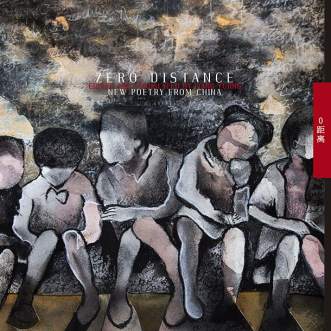
Mair on Zero Distance Anthology

Translator Denis Mair reviews Liang Yujing’s Zero Distance: New Poetry from China (Tinfish) for the International Examiner:

In the late 90s and early years of the new millennium, a polemical battle between “intellectual writing” and “populist writing” unfolded on Chinese websites … The populist camp was interested in developing China’s own native modernism; the intellectual writing camp seemed committed to working through Western modernist currents that had been interrupted during China’s period of leftist isolationism … we can hear reverberations of that clash in this concise anthology ably edited and translated by Liang Yujing. This svelte volume indeed gives English readers “a glimpse of what is being written in China now.” However, a random sampling would be confusing in a country where “good poetry can be found anytime anywhere…and good unknown poets can be seen at every corner of the land.”

This collection hangs together because the translator mines an authentic vein of native modernism. It also earns the title Zero Distance by affording glimpses into the life-experience of inquiring young minds since the new millennium.

Read the full review by clicking on the image above.

Peninsula Daily News Feature on Red Pine

Port Townsend’s Bill Porter, who translates Chinese poetry under the name Red Pine, is the 2018 recipient of the Thornton Wilder Prize for Translation by the American Academy of Arts and Letters. He heads to New York to pick up his prize next month. (Jeannie McMacken/Peninsula Daily News)When it was announced last month that Red Pine (Bill Porter) had won the American Academy of Arts & Letters Thornton Wilder Prize for translation, his local Peninsula Daily News went out to report.

The article covers his background:

He wanted to study anthropology with Margaret Mead at Columbia and applied for financial aid.

“I noticed there was a language fellowship funded by the defense department for those who wanted to study a rare language. I had just read a book by Alan Watts called ‘The Way of Zen.’ It made wonderful sense to me and it had some Chinese characters in it. So I wrote in Chinese on a whim. They gave me a four-year fellowship to study anthropology and Chinese. Chinese was hard.

“I met a monk in Chinatown and he taught me how to meditate and I started spending weekends with him at this retreat place. I realized this is what I wanted to to. It was much more interesting than studying.

“So I quit Columbia and went to Taiwan. A fellow grad student had the address of a Buddhist monastery. I studied Chinese so I went there. I stayed at two different monasteries and studied philosophy at a Chinese university.”

And also gets into his more recent international popularity:

“In China, there is a popular program on TV, like our Sex and the City. It’s the most watched program for people aged 20-40. Last May, the male lead told his girlfriend that she had to start learning more about Chinese culture and she should start with Bill Porter’s books. Fifteen hundred million people watch this program. Boom. I’ve been getting royalties from China ever since.”

With the Wilder award, he plans to buy a new car.

Fittingly, it is an Escape.

Click the image above for the full article.

Klein’s Duo Duo in Asian Cha

No automatic alt text available.

The new issue of Cha: An Asian Literary Journal is now live, and with it my translations of two new poems by Duo Duo 多多, “A Fine Breeze Comes” 好风来 and “Light Coming from Before, Sing: Leave” 从前来的光,唱:离去.

tomorrow’s already past
already offered
the past is still unknown
already spokenthe limit belongs to you
nobody can have that name

明天已经过去
已经给予
过去仍是未知的
已经说出 止境属于你
无人能有那名

Also in the issue are Bonnie McDougall’s translations of poems by Ng Mei-kwan 吳美筠, Jennifer Feeley’s translation of fiction by Xi Xi 西西, fiction by Eileen Chang 張愛玲 translated by Jane Weizhen Pan & Martin Merz, and Matt Turner reviewing Paul French and Kaitlin Solimine and Eleanor Goodman reviewing Richard Berengarten.
Click the image above to get to the issue.

Admussen’s Recite and Refuse on New Books in East Asian Studies

Image result for nick admussen recite refuseMiranda Corcoran interviews Nick Admussen about his monograph Recite and Refuse: Contemporary Chinese Prose Poetry–about Lu Xun 鲁迅, Bing Xin 冰心, Ke Lan 柯蓝, Guo Feng 郭风, Liu Zaifu 刘再复, Ouyang Jianghe 欧阳江河, Xi Chuan, and more–for New Books in East Asian Studies.

From the intro:

Published by the University of Hawaii Press in 2016, Nick Admussen’s exciting new book Recite and Refuse: Contemporary Chinese Prose Poetry explores the development of twentieth-century prose poetry within the unique political and cultural context of Communist China. In this ambitious study, Admussen attempts not only to define prose poetry but also to trace its ever-shifting role in modern Chinese society. In doing so, he produces a study which comprehensively analyses the dynamic manner in which Chinese prose poetry engages with a range of diverse cultural discourses, including science, popular culture and political rhetoric. Throughout the book, Admussen foregrounds the protean nature of the genre by exploring how prose poetry has been used by poets working both within and outside of official Communist Party strictures. Moreover, he identifies Chinese prose poetry as a unique tradition, distinct from Euro-American manifestations of the genre. In addition to these insightful analyses, Recite and Refuse also contains a number of original translations of important Chinese prose poems, including Ouyang Jianghe’s stunning “Hanging Coffin”.

Click the image above or listen here.

Audio clip: Adobe Flash Player (version 9 or above) is required to play this audio clip. Download the latest version here. You also need to have JavaScript enabled in your browser.