
Issue 14 of A Gathering of Tribes has officially arrived–featuring translations of Xi Chuan. The official release party has been scheduled:
Saturday, May 3, 2014 – 12pm-2:30pm
Bowery Poetry Club
308 Bowery
New York, NY 10012

Issue 14 of A Gathering of Tribes has officially arrived–featuring translations of Xi Chuan. The official release party has been scheduled:
Saturday, May 3, 2014 – 12pm-2:30pm
Bowery Poetry Club
308 Bowery
New York, NY 10012
 Dissertation Reviews has posted Steve Poland’s review of Chen Minjie’s dissertation, “Friends and Foes on the Battlefield“: A Study of Chinese and U.S. Youth Literature about the Sino-Japanese War (1937-1945). Here’s how it begins:
Youth literature is a powerful form of inter-generational storytelling, whereby one generation can pass along experiences of traumatic events to younger generations born into considerably different circumstances. In this capacity, youth literature also functions as a conduit of national myth-making and social reproduction, transforming a diverse multiplicity of individual lives into the recognizable types and tropes of desirable historical narratives. In her ambitious and insightful dissertation on the seventy-year role of youth literature in shaping postwar Chinese understanding of the Second Sino-Japanese War (1937-1945), Minjie Chen interrogates the nation’s authorization of who gets to tell the war story in two ways. First, as indicated in the subtitle of the dissertation, Chen uses a comparative framework to analyze the different ways youth literature in China and the United States has (or has not) offered ethnic Chinese youth a narrative connection to Chinese experiences of World War II. Second, Chen provocatively challenges the hegemony of male, conflict-centered youth literature in China by producing an oral history of the wartime experiences of women in Yunhe 云和, Zhejiang, demonstrating how a different trajectory for youth literature in China may have looked through the authorship of marginalized and excluded voices. The dissertation utilizes a variety of methodologies to show how youth literature (including lianhuanhua 连环画, or “popular pictorial reading material”) has over the course of seventy years contributed to both historical memories and amnesia surrounding the Second Sino-Japanese War that retain political, economic, and social significance today.
Click the image above for the full review.
 The Best Translated Book Award winners have been announced. But here’s Anna Rosenwong on why Steve Bradbury’s translation of His Days Go By the Way Her Years by Ye Mimi 葉覓覓 should win:
The ten exclamatory, cuttingly modern poems of His Days Go By the Way Her Years are shot through with sonic gamesmanship, punning, the unbridled verbing of nouns, and voraciously transcultural allusion. Many also perform an oscillation between coy formal disruption and seductive dream logic, as in the typographically resistant line: “\ every one of the ◻◻ / could find themselves sluiced by the ◻◻◻ into a water melon frappe of a summer season.” The poems are well aware of their own cleverness, but resist turning precious as they revel in grotesque particulars and subversions of the ordinary stuff of life and poetic diction.
Click the image above for the complete write-up.
 噫吁嚱危乎高哉!
At Language Log, Victor Mair posts (pictured here) a handwritten translation of a famous Li Bai 李白 poem, whose translator “said he was caught doing English homework in a Chinese class by his Chinese teacher. The teacher was angry and punished the student by making him translate Shǔ dào nán 蜀道难 (‘The Way to Shu Is Hard’) into English.”
For good measure, Mair posts a translation I did of the poem when I was a college senior, and published on CipherJournal.
Click the image above for the full Language Log post, and the fruitful discussion that follows.
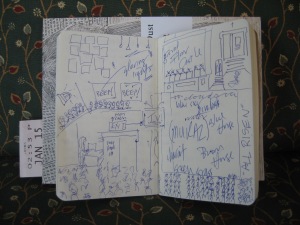 The Coming of the Toads blogs “On Jury Duty, Poetry Gaze, and Yu Xiang’s I Can Almost See the Clouds of Dust,” translated by Fiona Sze-Lorrain:
I take the Yu Xiang from my bag. I’m thinking of poetry gaze. In a land where poetry has been devalued beyond zero, isn’t every poem a sigh of dissentire? What is poetry gaze? I feel like Yu Xiang is watching me reading her poems. But she does not care what I think, nor even what I might be feeling. Then again, her poems are like
“…a door that says:
Be careful! You might lose your way”
Click the image above for the full post.
 Ouyang Jianghe 欧阳江河 has been named a writer-in-residence at Beijing Normal University. China Daily reports:
In a symposium at BNU on March 16, Yu Hua 余华 called Ouyang a “broad and complex” poet for relating history to modern times. Mo Yan 莫言, who won the Nobel Prize in Literature in 2012, said Ouyang’s poems always touch on the essence of life and the poet has the ability to make his culturally profound and philosophical poems understandable to the general public.
While compliments were paid to Ouyang’s literary achievement at the symposium, the poet said he wants to hear more criticism. He said that since many new things have occurred so rapidly in modern poetry over the past three decades, it’s harder for classics and milestone pieces to emerge.
“Our poems are still just the questions, not the answers,” he said.
Ouyang also said during the symposium that one of his biggest childhood dreams was to become a college professor. However, he never had the chance to even attend college as he was already 35 when he retired from his service in the army.
Click on the image for the full article.
 Peony Moon has published an interview with Han Dong 韩东 as conducted by his translator Nicky Harman. Here’s a teaser:
NH: You famously said that, “poetry does not go beyond language” (“诗到语言为止“). Do you still believe that? If not, what do you think are the most important principles of poetry?
HD: When I said that, it was to counter the prevailing view (in China) that “the written word must express a moral view”, and to emphasize the importance of language in poetry. But ultimately this was just another creed and, to that extent, one-sided. I understand poetry in a more rounded way now, not just as in opposition to something else. Poetry is an absolute, or at least an indication of an absolute. Analysing poetry is of limited use. Poetry doesn’t exist in the abstract, only in specific poems, in the writings of a particular poet, and we shouldn’t try to over-explain it. I dream of being able to write poems which need little or no explaining, and can be understood intuitively. Readers don’t need training but poets do, and that training ought to include how to stir people’s hearts.
Click on the image above for the full interview.
 Dissertation Reviews has posted Zhu Yanhong’s review of Wang Yanjie’s dissertation, The “Sent-Down” Vision: Poetics and Politics of Zhiqing Literature in Post-Mao China. Here’s how it begins:
Zhiqing 知青 writers are often considered by literary critics as a generation who express a profound sense of nostalgia in their writing. Yanjie Wang’s dissertation The “Sent-down” Vision: Poetics and Politics of Zhiqing Literature in Post-Mao China is an insightful and probing study that challenges this conventional yet still prevalent view of zhiqing literature. Defining the zhiqing generation rather as rootless and displaced, Wang skillfully investigates what she calls the “sent-down” vision of the zhiqing writers. She convincingly demonstrates that such a vision is enabled and enriched by zhiqings’ decade-long rustication experience and that the past associated with the sent-down experience is invoked not simply to express nostalgic feelings but rather to offer a “critique of contemporary China’s massive modernization project” as driven by developmentalism, materialism, and consumerism (p. 1).
Click the image above for the full review.

The 3rd Convention of the Chinese/American Association for Poetry and Poetics will take place in Shanghai from December 18 to19, 2014. This convention will be hosted by Shanghai University and co-sponsored by Central China Normal University, Foreign Literature Studies, Forum for World Literature Studies, University of Pennsylvania, and China Three Gorges University. Papers are called from scholars all over the world.
I. Conference Topics
1. Modern and contemporary poetry and poetics
2. Meaning/politics of poetic form
3. On and off the page: Poetry, society, culture
4. Poetry in the genealogical perspective: the evolution (and devolution) of poetic genres
5. Poetry and poetics in the context of comparative literature and comparative arts
6. Poetry in the global context: Diffusion, exchange, conflict
7. Poetry and new media
8. Poetics of translation
For the full call for papers at Charles Bernstein’s blog, click the image above.