Tammy Ho on Contemporary Faces of the River Merchant’s Wife

Writing at World Literature Today, Tammy Ho Lai-ming 何麗明 talks about the “Contemporary Faces” of “The Merchant River’s Wife: A Letter,” Ezra Pound’s translation of Changgan Xing 長干行 by Tang poet Li Bai 李白 (whom he called Rihaku) in Cathay (1915). Specifically, she focuses on contemporary extensions, responses, and rewritings: Luca L.’s “Letter to Ru Yi, the River-Merchant’s Wife”; “The Expat’s Partner: An Email,” by Alistair Noon; and “Ghost Husband,” by Renée M. Schell. Here’s how she ends her piece:

In his introduction to Derrida’s ideas of deconstruction and photography, the painter Gerhard Richter suggests that translation means that “something is presented, interpreted, explained, and even understood in terms of something else.” Seen in this way, the three contemporary poems discussed can be called transgender, transtemporal, and transcultural translations of Li Bai’s poem, read through the prism of Pound’s rendering.

Click on the image for the full article.
Gao on Feeley’s Xi Xi

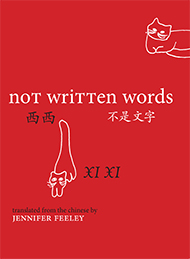
notwritten_wAt the Hong Kong Review of Books, Yunwen Gao reviews Jennifer Feeley’s translation of Not Written Words 不是文字, by Xi Xi 西西:

Covering a wide range of poems from 1961 to 1999, Not Written Words is the first collection of Xi Xi’s poems selected from Stone Chimes (1982) and The Selected Poems of Xi Xi: 1959-1999 (2000) translated in English. The 168-page book is a nicely edited collection with the original text in Chinese and the English translation facing each other, as well as translator’s notes attached at the end of the book. Being multilingual and well-read in world literature, Xi Xi molds her poems into a versatile medium to connect literary traditions from different cultures and address issues across the globe. Her sources and influences include classical Chinese poetry and Western poetry. Readers will find references to French New Wave cinema (“At Marienbad”), The Book of Songs (“Pebble”), Tang poems (“Moon”), English metaphysical poems (“Aria”), Allan Ginsberg’s poem “A Supermarket in California” (“Supermarket”) in her writing, to name just a few. Thanks to the translation, readers of world literature can learn more about Xi Xi’s career as a poet in addition to her fictional writing.

Click the image above for the review in full.

Ndesandjo’s Li Shangyin at A Tang Poet from Nairobi

no-21A Tang Poet from Nairobi is a new website featuring the collected poems of Li Shangyin 李商隱 as translated by Mark O. Ndesandjo, with his calligraphy and often contextualized with anecdotes or fictions of his own. Such as:

I once visited a city in a strange land called America. The people there were stoic and violent. They also were so alone, as though they had never had a father or a mother, and were always flying in the cold air without roots to tether them to the earth. The path of solitude, their president had declared, is the only one worth valuing. It was winter in Boston. As was my wont, I spent the evening looking for sordid pleasures, or love for sale. The alley was narrow, surrounded by brick walls far larger and higher than anything in Chang’An. In the darkness I saw the figure of a woman. Her body was lithe, and the shadows slashed her face. With a little hesitation I passed her and then, a few yards away, turned back. She was waiting for me by some large refuse bins …

The story continues, and is followed by his translation:

Princess Shou Yang’s marriage makeup is bold,
Noble slanted eyebrows touch a forehead sparkling with gold,
Seeing me, she pretends to blush, as usual just for show!
Regarding this whoring rascal, how little does she know!

寿阳公主嫁时妆,
八字宫眉捧额黄。
见我佯羞频照影,
不知身属冶游郎。

Ndesandjo writes:

I want the general public to know the Chinese wrote great poetry, and help avoid searching for this great poet’s works in bits and pieces. Furthermore, not being a professional translator, I wanted to post my interpretations as a work in progress that will benefit from other’s input and ideas, including academics. Finally, I think it is important to express personally how Li Shangyin’s insights can inspire across three cultures: America, Kenya, and China.

Click the image above for all the poems.


PEN/Heim Translation Grant for Admussen’s Ya Shi

Nick Admussen has received a 2017 PEN/Heim Translation Fund Grant for his forthcoming translation of Floral Mutter (Zephyr Press), the selected poems of Ya Shi 哑石, which PEN describes as a “master of disjunctive imagery.”

Ya Shi brings language to the precipice of the absurd and holds it over the abyss for all to see. Admussen’s translations, which are perfectly balanced and polished, recreate the source poems for us in a language the judges described as “haunting.” In an age when contemporary Chinese poetry is profoundly influenced by its eastern urban centers, Ya Shi stands out as an inimitable voice from the interior.

To demonstrate, they cite:

In the summer           slit open a plump, cool lotus root
taste the sweet juice frothing up from its orifices.
On the rooftop           a dense and scorching pressure crowds inward
but… it’s vague and speechless like the long wind.
The great many cruelties of life have gone ignored for ages.
— and what is loathsome is more or less similar
for all that is vulgar, keep strumming on your shiny oddity!

Click here for the full list of grantees.

Eleanor Goodman on Contemporary Chinese Poetry from Zephyr

somethingcrosses_w

As part of Paper Republic‘s series of blogs for Global Literature in Libraries throughout February, Eleanor Goodman writes on Zephyr Press, which she says “has done more to raise the profile of contemporary Chinese poetry in English translation than any other press today”:

Their books are carefully curated, well edited, and beautifully produced. Above all, their translators (here I must profess that I am one of them) tend to be at the top of the field, which is of course essential to the making of a good book in English.

Alongside mentions of their publications of Han Dong 韩冬, Bai Hua 柏桦, Lan Lan 蓝蓝, and Yu Xiang 宇向, Goodman specifically writes about her translation of Wang Xiaoni 王小妮, about Andrea Lingenfelter’s translation of Zhai Yongming 翟永明, Austin Woerner’s translations of Ouyang Jianghe 欧阳江河, Jennifer Feeley’s translation of Hong Kong poet Xi Xi 西西, Steve Bradbury’s translation of Taiwanese poet Hsia Yü 夏宇, and my own forthcoming translations of Mang Ke 芒克.

With with “deep resources of scholarship and natural talent to draw upon,” she writes, it is

this mix of qualities—the best of the contemporary Chinese poetry world combined with translators who are also careful readers and appreciators of poetry—that makes the Zephyr collection so unique and valuable. These books are a labor of love from start to finish, and it shows in the final products. There is simply no better introduction to the contemporary Chinese poetry scene available today.

Click the image above for the full article.

Balcom’s Ya Hsien on PEN Translated Poetry Shortlist

Abyss, poems by Ya Hsien 瘂弦, translated by John Balcom (Zephyr Press), has been shortlisted for the 2017 PEN Award for Poetry in Translation.

The $3,000 award recognizes book-length translations of poetry from any language into English published during the current calendar year. The winner will be announced on February 22, 2017 and honored at the PEN America Literary Awards Ceremony on March 27, 2017.

Click on the image for the list of finalists.

Lung Cancer Poem Gets International Attention

The New York Times is reporting on a poem by Zhao Xiaogang 赵晓刚, MD, published in CHEST, the official publication of the American College of Chest Physicians, titled “I Long to be King” 我要当老大. Written “from the viewpoint of an ambitious lung cancer that revels in the ‘delicious mist and haze’” of China’s air, the poem has now been gaining international attention. The Times writes:

The author, Dr. Zhao Xiaogang, 40, who is deputy chief of thoracic surgery at Shanghai Pulmonary Hospital of Tongji University, opens with a “ground-glass opacity,” an image of a CT scan of fluid in the lungs that can indicate a range of disorders, but in this case is the first indication of what will develop into a triumphantly lethal cancer.

According to the article, “Dr. Zhao has long written poetry as a pastime. But in 2015, while a visiting scholar at the University of Nebraska Medical Center in Omaha and at Washington University in St. Louis, he heard that some academic journals published poetry.” No word on who translated the poem, though (presumably Zhao himself?).

From the poem:

I am ground glass opacity (GGO) in the lung,
A vague figure shrouded in mystery and strangeness,
…
My continuous growth gives me a chance to be king,
As I break through layers of obstacles,
Spanning the mountains and waters.
My fellows march to every corner and occupy every region.

肺部磨砂玻璃影是我的大名,
朦胧的身影披着神秘与诡异,
……
继续成长的我有机会成为老大,
突破层层壁垒、跨越千山万水,
每一根血管都有我的手下子民,
每一处脏器都有我的旌旗招展。

Click the image above for the Times write-up, here for the full translation from CHEST, and here for excerpts in Chinese.

Hockx’s Snowy Morning Available for Free Download

ThumbnailMichel Hockx’s seminal study, A Snowy Morning: Eight Chinese Poets on the Road to Modernity (Research School CNWS, 1994), is now available for free download.

Literary historians tend to deal with China’s earliest ‘new poets’ with scant regard. These poets are thought to have been the experimenters, the forerunners whose only task it was to fail so that others might succeed. Their pluriform and many-sided work is consequently only discussed in footnotes and introductory chapters.

Focusing on the poetry and poetics of the eight authors of A Snowy Morning (1922), and on contemporary and modern reception of their work, the present study not only offers a detailed view of the period during which modern Chinese poetry took shape, but also presents a new outlook on the modernity of early ‘new poetry’ itself.

Click the image for the .pdf.

Balcom’s Ya Hsien on PEN Translated Poetry Longlist

Abyss, poems by Ya Hsien 瘂弦, translated by John Balcom (Zephyr Press), has been longlisted for the 2017 PEN Award for Poetry in Translation.

The $3,000 award recognizes book-length translations of poetry from any language into English published during the current calendar year. Finalist will be announced on January 18, 2017, with the winner announced on February 22, 2017 and honored at the PEN America Literary Awards Ceremony on March 27, 2017.

Click on the image for the full longlist.

Jeffrey Yang on Translation

Jeffrey Yang, poet, editor, and translator of Uyghur and Chinese poetry (both classical and modern, including Liu Xiaobo’s 刘晓波 June Fourth Elegies, Su Shi’s 蘇軾 East Slope, and Bei Dao’s 北岛 forthcoming memoir City Gate, Open Up) answers questions as part of Words Without Borders‘ “Translator Relay“:

You are a translator, but also an award-winning poet. Can you speak about how your work as a poet informs your translations? And in turn, do you find that your work as a translator informs your poetry?

I try not to dissect this back and forth too much as the two so naturally fit together, like Adam and Eve. Both require careful attention to the musical qualities of language. The two can also overtly overlap, in that translating a poem is akin to writing a poem in a new language, or when writing a poem includes translated lines from another language. Both practices thrive in obscurity and with patient tinkering at the minutest level of word and line. As the recent Nobel Laureate said fifty years ago, “People have one great blessing—obscurity.” Each revels in an economy of language while persisting outside of the day-to-day economy, where profit never ventures upon its threshold. The one feeds the other in body and spirit, as with the other arts.

Click on the image above for the full Q & A.