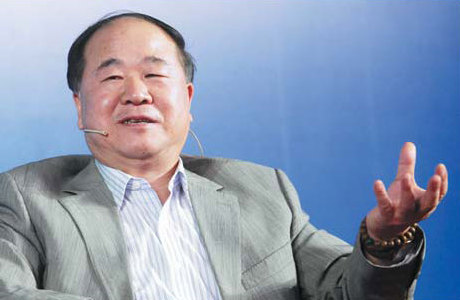
Even more Mo Yan

Translators need to strike a balance“An Epic Tale of Comic Realism”: a reader’s words on Life & Death are Wearing Me Out.

Peter Tieryas Liu on Sandalwood Death:
The best of Chinese literature doesn’t just give insight into the Chinese condition, but that of all humanity. Mo Yan’s specialty is the uniquely local spectrum through which he plays out the tragicomedy of life as in this case with a rebellion in a small town and its cast of eclectic characters.

And Mo Yan on translation in conversation with Adonis:

“From the perspective of literature and art, it’s undoubtedly a huge loss. My attitude is, forget the translators when you write. Care not about whether they feel happy to translate. The real talented translators aren’t afraid of difficulties,” he says.

[not that I know who translated that passage]

In “White Happy Doves,” Nikil Saval reviews Change, Pow, and Sandalwood Death for the London Review of Books:

When the English translation of Mo Yan’s novel Big Breasts and Wide Hips (1996) was published in 2004, it was seen by some critics as his bid for global literary prestige. It hit all the right notes: it was a historical saga of modern China featuring a proliferation of stories, it was unceasingly violent and nasty, and it came near to puncturing Party myths … the Washington Post praised Mo Yan for having ‘spoken out courageously for freedom and individualism’. Here was a liberal voice in repressive China. ‘The Swedish Academy, which leaps at any chance to mix literature with politics,’ he concluded, ‘might well find in Mo Yan just the right writer through whom to send a message to the Chinese Communist leadership.’

Last year the Academy did indeed give Mo Yan the prize. But this time the Nobel’s literature-politics mix came out all wrong. Rather than taking it as a targeted affront, as it had with the Peace Prize awarded to Liu Xiaobo two years earlier, the Chinese Communist Party was ecstatic. Li Changchun, minister of propaganda, wrote to congratulate Mo Yan on a victory that ‘reflects the prosperity and progress of Chinese literature, as well as the increasing national strength and influence of China’. Mo Yan’s dissident reputation in the West, it turned out, was false. He was an established figure in Chinese literary officialdom. He had been a member of the Communist Party since 1979. He was vice chairman of the China Writers’ Association. He had participated in a public ceremony in which he copied out several Chinese characters from Mao’s Zhdanovite ‘Talk at the Yan’an Forum on Literature and Art’, a text which declared the subservience of literature to the class struggle. And in Stockholm before receiving the prize, Mo Yan spoke up in favour of censorship: it was, he said, a bit like airport security. The cadres were already moving swiftly to turn his ancestral village into a literary theme park.

Brendan O’Kane, interviewed by Jeffrey Wasserstrom for LA Review of Books:

Mo Yan didn’t send Liu Xiaobo to jail, and there is absolutely nothing he could say or do, up to and including getting the words “FREE LIU XIAOBO” tattooed on his bald pate, that would do one bit of good for Liu Xiaobo or anyone else in China. (This is especially clear given the Chinese government’s continued persecution of Liu’s brother in law Liu Hui, and the ongoing extrajudicial house arrest of Liu’s wife Liu Xia: the authorities are impervious to moral argument, and they have no shame.) Mo is a deputy chairman of the China Writers’ Association, which is to say that he has slightly less power, in actual terms, than your average deputy chairman at the National Endowment for the Arts in the US. Meanwhile, as much as we might wish otherwise, moral/political courage and literary merit are not the same thing — if writing bad poetry were a criminal offense, Liu Xiaobo would never see daylight again. So I wrote that post on Rectified.name in hopes of getting people to disentangle the two. Once you do that, and once you actually read Mo Yan’s books, I think you find that he’s a much sharper writer than he’s been given credit for. His books don’t make any kind of overt criticisms of the system — perhaps because he’s overly cautious; perhaps because he’s just not much interested in lifting his gaze from the village level — but they are all, in one way or another, about the human suffering created, perpetuated, and intensified by that system.

Julia Lin Obituary

Julia Lin Julia Chang Lin, a scholar of Chinese literature who brought a forgotten generation of women poets in China and a new generation of post-war Chinese women poets to a western audience, died on Thursday, Aug. 1, of complications from neuroendocrine cancer in New York City. She was 85.
…
At Washington, she developed her skills as a writer and translator of poetry. She spoke Mandarin, Shanghainese, an Amoy dialect (her summer language), English, Cantonese, French, Fukienese (her husband’s native tongue), and a bit of Japanese. One of her teachers, Theodore Roethke, liked one of her poems, “Song of the Crazy Monk,” so much that he mailed it off to the prominent literary journal Botteghe Oscure, which published it. It was Julia’s first publication. Her thesis advisor at UW was so impressed with her PhD thesis that he helped secure its publication as “Modern Chinese Poetry: An Introduction.”
…
Dr. Lin made groundbreaking contributions to the field of modern and contemporary Chinese poetry. “Modern Chinese Poetry: An Introduction,” completed shortly after the Nixon detente made visits to China possible, enabled her to go to China to gather poetic materials and small literary journals and produce pioneering scholarly/critical studies of modern and contemporary Chinese poetry. Lin became friends with many of these poets, including Shu-Ting, who was persecuted during the “anti-spiritual pollution” movement that was launched in 1983. Among the poets translated in her first book, was Ping Hsin and Lin Huiyin whose short lyric mini-poems were pioneering works in modern China. At Ohio University she helped inaugurate Chinese language courses and, in her courses and colloquiums, she was the one-person Asian Studies department, introducing students to “The Tale of Genji” and “Journey to the West.” After retiring in 1998, she continued to champion the works of women writers in China. Her four books have been influential in bringing recognition to, and appreciation of, Chinese women poets from mainland China and Taiwan.
…
She is survived by a daughter, Maya, the artist who created the Vietnam Veterans Memorial, and a son, Tan, a poet and English professor, both of New York City; a brother Ke-Heng of Beijing; a stepsister, Yining Zhang of Lawrenceville, N.J.; and three grandchildren, Ahn Churchouse Lin, Rachel Ming Wolf and India Lin Wolf.

Click the image for the full article.

Yu Xiang reviewed on Words Without Borders

Image of Yu Xiang’s “I Can Almost See the Clouds of Dust” I Can Almost See the Clouds of Dust, the new poetry collection by Yu Xiang 宇向 translated by Fiona Sze-Lorrain, has been reviewed on Words Without Borders by Naomi Long Eagleson. Here’s how it begins:

Yu Xiang’s poems are the poetic equivalent of shoegazer rock. She takes the mundane—a whiff of cigarette smoke, a falling leaf, a housefly—and stares at it so intently that it splits open to reveal something unexpected. In the introduction to I Can Almost See the Clouds of Dust, the translator Fiona Sze-Lorrain writes that Yu “is adamant that a mundane life does not lack poetry. Rather, it lacks being discovered.” And indeed, throughout this bilingual collection the everydayness of life is keenly observed, giving rise to poems that reveal as much about the self as they do the world.

Click on the image above for the full review.

Moving Beyond: Chinese Modern Abstract Art in Edinburgh

moving-imageSix contemporary Chinese artists (Liu Guofo, Guan Jing Jing, Yang Liming, Liang Qian, He Gong and Wu Jian) will be exhibiting works in an arts project conceived by Chinese poet Yang Lian and Dr Janet McKenzie (Editor: Studio International). The exhibition seeks to open a new page on contemporary Chinese Art, to move forward from the perception in the West of a contemporary Chinese art, based on many artworks that are in the view of Yang and fellow artists and intellectuals who experienced the Cultural Revolution at first hand, largely derivative of Western language and sources and failing to do justice to the diverse work being produced by artists who seek a deeper intellectual and spiritual standard in their work, a canonical basis for Chinese contemporary art.

Poetry on Fire: Xi Chuan & Helen Wing at M Restaurant Beijing

Sunday, August 25, 4 p.m.
RMB 75, includes one drink


Poets Helen Wing and Xi Chuan come together to explore the idea of poetry as fire, from the fire imagery in their poems to their views on how the poetic imagination spreads, like fire, beyond borders. Writing in English (Helen) and Chinese (Xi Chuan), their work suggests that (with apologies to Robert Frost) poetry is not, after all, lost in translation.

The event promises to be excellent (I’ve hated Robert Frost for that line long enough, but now it’s time people were aware that David Bellos has demonstrated that “nobody has ever been able to find Frost saying anything like it in his works”). And here’s Helen Wing’s bio:

Helen Wing is a poet and a fiction writer who lives variously in Beijing, Cairo and London.  Currently she is Writer-in-Residence at Harrow International School, Beijing and works part-time at Renmin Da Xue. At Harrow, she promotes poetry writing with the students and publishes an annual poetry book project, done jointly with Harrow students and the students at Project Hope Vocational School, a migrant children’s charity school based in Wangjing.  Her poetic work, Archangel, rose to number four on Amazon’s e-kindle poetry list last year. Other poems have been published in a recent Middle Eastern anthology, Nowhere Near a Damned Rainbow: Unsanctioned Writing of the Middle East. Her stories have been published in the Mississippi Prize Review, the Southern Cross Review, in the Tale of Four Cities and Sukoon. She is currently working on a novel called I swore I’d set that donkey free before I left Beijing.

Born in London, Helen studied Spanish and French at Cambridge University and holds a PhD in Spanish poetry.

Xi Chuan and Lucas Klein recording at Harvard’s Woodberry Poetry Room

PhotographThe Woodberry Poetry Room at Harvard has finally uploaded our recording from last March!

The Woodberry website lists titles in pinyin because it doesn’t support Chinese characters, so here are the titles for what we recorded in Chinese with English translation:

无关紧要之歌 A Song of no Matter

墙角之歌 A Song of the Corner

窝藏着我的尾巴 I Bury My Tail

关于黑暗房间里的假因果真偶然 On False Causality and True Chance in a Dark Room

厄运 Ill Fortune

熟人 Acquaintances

伴侣 Companion

我奶奶 My Grandmother

蚊子志 Notes on the Mosquito

Thanks to Chloe Garcia Roberts for the arrangements!

Click on the image above to link to the virtual listening booth.

The Translators behind In Translation: A Conversation with Esther Allen and Susan Bernofsky

Esther Allen and Susan Bernofsky

Translators in the anglophone world are sometimes perceived as being on a “lower rung.” The essays in our book certainly don’t subscribe to that view. Would we say that an actor is on a lower rung than the screenwriter who wrote the lines the actor delivers? Or that the literary critic is on a lower rung than the writers whose works she analyzes? The contributors to our book all write and translate and have made careers that conjoin the two practices—that conjoining is what many of the essays we’ve included are fundamentally about.

Click the image above for the full interview.

Fiona Sze-Lorrain featured in China Daily

Solving a riddle with a harp and the magic of words

“Solving a riddle with a harp and the magic of words”

As a student at Columbia University, she dabbled in theater, writing and East Asian studies, and came to realize that there was more to be understood in the space between words and cultures, she said. Studying her own heritage from an intellectual perspective allowed for an ambivalence she had never indulged, and poetry provided an outlet for evolving views.

When she struggled with writing, she found solace in source material and the writing of other poets; from there, she discovered the pleasure of translating Chinese works. She has since translated books by the poets Yu Xiang, Bai Hua and Yi Liu, among others.

Click on the image for the full article.