Xi Chuan Interview part II

Two weeks ago I linked to part one of Paul Nelson’s SPLAB interview with Xi Chuan. Paul has recently uploaded part two, which continues to show the  depth and breadth of Xi Chuan.Whereas part one spent more time on Xi Chuan’s personal history, however, in part two he discusses details from his poems “Exhortations” 箴言, “A Personal Paradise” 个人的天堂, “Ill Fortunes” 厄运 (which he reads, in English), and “Notes on the Mosquito” 蚊子志, as well as the developments in Chinese poetry since the era of the “Misty Poets” 朦胧诗人 in the ’80s. Add to this both Xi Chuan’s take on the politics of the history of Chinese and American interaction and Paul’s “American Sentence,” “A bureaucrat is someone great finding reasons why they can’t help you,” and this is clearly an interview worth listening to. Here’s Paul’s write-up:

Xi Chuan, peN

While in China for the 3rd Qinghai Lake International Poetry Festival this past August, I met one of the most renowned younger Chinese poets, Xi Chuan. He has a book coming out next year entitled Notes on the Mosquito, published in translation by New Directions. In Seattle recently to celebrate the release of an anthology of contemporary poetry from China, Push Open the Window (Copper Canyon Press) he talked about the opening in Chinese poetry after the Cultural Revolution. SPLAB Presents for the week of October 17, 2011.  Part one of the interview.  Part two is here.

SPLAB Presents airs Thursdays at 4:30 p.m. on KBCS.FM, 91.3, or you can listen to the interview here.


Push Open the Window Write-up

Over at Writing Without Paper Maureen has posted a quick write-up of Copper Canyon Press’s NEA-sponsored anthology of contemporary Chinese poetry, Push Open the Window. An informative list of details more than a review proper, it’s nonetheless valuable for its collection of links to Chinese poetry in English translation, as well as the personal or academic websites for a number of translators. Also, I appreciate that she includes my translation of Xi Chuan along with her quotations of Steve Riep‘s Zhou Zan and Jonathan Stalling / Huang Yibing‘s Mang Ke. You can read the entire post here.

Yours Truly & Other Poems

My copies of Yours Truly & Other Poems, the Tinfish Press chapbook of six of my translations of recent Xi Chuan pieces, just arrived in the mail today. Here are the contents: “Unusual” 反常, “I Bury My Tail” 我藏着我的尾巴, “The Neighbors” 邻居, “Somebody” 某人, “The Plains” 平原, and “Yours Truly” 小老儿. Here’s how it looks: (click on the images to order yours for only $3.00 in greenbacks!)

Xi Chuan will be reading at the International Poetry Nights in Hong Kong, which will take place this November 10 – 13. He’ll be joining nine other Chinese-language poets from the Mainland, Taiwan, and Hong Kong, as well as ten international poets from Arkadii Dragomoshchenko and C. D. Wright to Tomaž Šalamun, Paul Muldoon, and Vivek Narayanan. Click on the image below for registration and further details:

Translation & Cultural Distinction

In his introduction to Xi Chuan and Zhou Zan from their 92nd St. Y reading on October 10th, Forrest Gander referred to something his Brown University colleague John Cayley had said about classical Chinese poetry in English translation. Sylvia Lin and Howard Goldblatt, the translation editors of the NEA anthology Push Open the Window, also picked up on the same statement, writing in their “Translation Co-Editors’ Preface”:

When we agreed to take on this exciting project as translation editors, we were reminded of a comment that has long resonated with us, as readers and translators of Chinese literature and as “shameless” promoters of the best of it, in the original when possible and in translation otherwise. John Cayley, himself a translator and a publisher of Chinese poetry in translation, has written: “Incontestably, the translation of classical Chinese poetry into English has given us a body of work which is culturally distinct from the poetry of its host language but which has immediate appeal, and is often read with intense pleasure and a deep awareness of its moral and artistic significance.” The challenge, for us, was to assist in bringing over contemporary poetry from China such that Cayley’s assertion could be modified by replacing a single word and remain true.

This is interesting to consider. Certainly what Cayley says is true, that English translations of classical Chinese poetry have been loved by readers and influential to poets who have little or no knowledge of Chinese as a language or a culture otherwise; Eliot Weinberger‘s early Nineteen Ways of Looking at Wang Wei and more recent New Directions Anthology of Classical Chinese Poetry are testaments to this fact. And yet, when it comes to contemporary Chinese poetry, I’m not so ready to agree (I’ve been critical, for instance, of anthologies of contemporary Chinese poetry that seem to exploit the creativity of the translator and suppress what makes the original original).

Certainly translating a poem from a thousand years ago and a poem from this decade are somewhat different activities. Certainly the cultural distinction of contemporary Chinese vis-à-vis the contemporary anglophone world is much less than the cultural distinction of China in the Tang or Song. Do facts of proximity–from globalization to immigration to travel to…–mean that we translators have less cultural leeway when dealing with contemporary Chinese writing than with writing from ancient China? In other words, do we have to make our translations less culturally distinct from their originals because contemporary Chinese originals are already closer to us than ancient Chinese originals? I find this question especially relevant to translating Xi Chuan, who often incorporates a view of classical China from (for instance, his series “Thirty Historical Reflections” 鉴史三十章).

This deserves more thought, of course, and I certainly don’t want to prescribe anything all translators everywhere have to follow. I will say this, though: my goal in translation is to satisfy three kinds of readers, those who read Chinese poetry, those who read poetry in English, and those who read translations. If I don’t think what I’ve written satisfies those three very different sets of demands, I don’t think I’ve written a good translation.

The Editor’s Edits

After weeks of delays and worrying (the first package vanished somewhere between New York and Hongkong, so a copy had to be re-sent from another service), the editor‘s notes on Notes on the Mosquito, my translation of Xi Chuan’s selected poems, arrived yesterday.

Looking at this is both humbling and exhilarating. Can’t wait to get to work!

Jia Zhangke’s Platform

In addition to being a poet and essayist, Xi Chuan has also worked as a film actor. In Platform 站台 (2000), directed by Jia Zhangke 贾樟柯 about personal and artistic changes in Shanxi 山西 province from the ’70s to the ’90s, he plays a theater director from Beijing modeled in part off the poet Mang Ke 芒克 (co-founder of the journal Jintian 今天, and whose poetry I should be translating soon). Here’s the English-language trailer:

I’m still looking for an excerpt of one of Xi Chuan’s scenes with English subtitles, but the entire movie is available on youku.com. Xi Chuan appears at about 3:38, in disbelief that his troupe has never seen a train in person and berating them for unrealistic acting and individualism; at 32:31, interrogating a misbehaving actor about the goals of socialism under “reform and opening up” 改革开放; and again at 37:13, where his speech indicating the troupe’s future direction is, tellingly, interrupted by a solo flamenco performance.

Forrest Gander’s Introduction of Xi Chuan & Zhou Zan

The night of October 10 (the hundred-year anniversary of the Xinhai Revolution 辛亥革命 that ended the Qing Dynasty 清朝), Forrest Gander introduced Xi Chuan, Zhou Zan, Marilyn Chin, and Li-young Lee at Manhattan’s 92nd St. Y. Here’s the text of his introduction:

This occasion is as much a celebration of poetry as it is a celebration of translation, that art that plucks from our black hats and blank looks the passport permitting us to cross borders of culture, language and imagination.

But what if the translations are bad?  Picasso claimed, “You don’t need the masterpiece to get the idea,” but is this true of translations?

Historically, mistranslations have contributed in signal ways to literary movements. The supposedly newly discovered poems of third-century warrior-poet Ossian—in translations forged by Scot prankster-poet James MacPherson and then really translated into German—fueled Johann von Herder’s Romantic re-conception of German poetics in the 18th century.

And like von Herder, American poet Ezra Pound helped launch a literary movement stimulated, in part, by translations based on a mistaken interpretation of the nature of the Chinese writing system. Ernst Fenollosa, Pound’s source, was studying Chinese grammar in Japan with Japanese linguistic scholars.

Many of the Chinese poets included in Push Open the Window, the new anthology from Copper Canyon, cut their teeth on bad translations of American poetry. Somehow, they were sufficient for them to get “the idea.”  Or, more importantly for their own work, not necessarily “the” idea but “an” idea.  In the 1980’s and 1990’s in China, better translations– Yunte Huang’s version of Ezra Pound’s Pisan Cantos, for instance, Zheng Min’s pioneering Contemporary American Poetry, and Zhao Yiheng’s Modern American Poetry anthology– began to appear. But poets like Bei Dao, who says he looked abroad for models, and Yang Lian, whose book Concentric Circles is strongly influenced by Pound’s Cantos, had already forged their signature styles. A somewhat younger poet, Yu Jian, discovered translations of Whitman while working in a factory and went on to write poems that reference important but less celebrated American poets like Ron Padgett. Xi Chuan, who straddles two named factions of poets (the Misty and the New Generation Poets), studied English Romantic poetry and wrote a dissertation on Ezra Pound. The post-Mao-generation poets Hu Xudong, who cites Mark Strand and Robert Hass as influences, and Zhou Zan, who translates from English and cites among her influences Denise Levertov and Adrienne Rich, came of age as internet translations of American poetry exploded in China. Both Zhou Zan and Hu Xudong came to study in America, Hu Xudong at the International Writing Program in Iowa and Zhou Zan at Columbia University. Zhai Yongming, also included in Push Open the Window, speaks little English but wrote a whole book documenting her road trips through the deserts and mountains of the American west.

Just this year, at a literary conference in Wuhan, Chinese scholars offered papers on Wallace Stevens, Hart Crane, Elizabeth Bishop, Sylvia Plath, Rita Dove, Charles Olson, William Carlos Williams, and ecopoetry, all that remarkable variety squeezed between twenty panels devoted to the work of Charles Bernstein.

My colleague at Brown University, John Cayley, himself a translator and a publisher of Chinese poetry in translation, notes that historically, English-language translations of Chinese poetry offered to American readers a literature that was “culturally distinct from the poetry of its host language” however much it might be read with “intense pleasure….”

But that, too, has begun to change and more culturally contextualized poetics and better English translations are revising America’s engagement with Chinese poetry. In the United States, the mid-1980s saw the publication of Eliot Weinberger’s essay “A Few Don’ts for Chinese Poets” and his classic translation study 19 Ways of Looking at Wang Wei. More recently, several major anthologies, Michelle Yeh’s Anthology of Modern Chinese Poetry, Zhang Er’s Another Kind of Nation: An Anthology of Contemporary Chinese Writing, Arthur Sze’s Chinese Writers on Writing,  Qingping Wang’s Push Open the Window, and The New Directions Anthology of Classical Chinese Poetry have indeed unlatched the shutters and pushed open the window.

The China-born Ha Jin, mostly known in the United States as a fiction writer who writes in English, says that if he wrote in Chinese now, he would write poetry, not fiction, because “at this moment, poetry is more promising. It can do more for the language.”

Given the explosive richness of contemporary poetry in America now, I would suggest that here too, in this historical moment, poetry offers the most to literature in English.  The early 21st century is one of the most turbulent and critical times for poetry in the cultures of both countries.

Just as American poet Marilyn Chin shuffles fragments, for example, from John Berryman with her own nervy colloquial precision, and unsplices the resonant emotional and political implications of immigrant narratives within American mythologies and vice versa, the Chinese poet Xi Chuan considers China’s past through the lens of a modernized West; he shuffles antique dictions with colloquial ones; he braids the analytical essay with the ode to things. But though he wrote a dissertation on Pound’s Chinese cantos, his work seems most influenced by European philosophy and literature, Kafka, I’d guess, and Nietszche. Chinese poet Zhou Zan, whose poetry often focuses on the process of creation, sometimes writes in short parabolic descriptive sentences and at other times juxtaposes paratactic clauses in stanzas that incorporate multiple voices and windmilling social and personal observations. Well-known American poet Li-young Lee animates his own family memories with a famously sensual palette.

In the writing of Marilyn Chin and Li-young Lee, the entanglement of cultures and languages collaborates with theme and style. Other American poets, notably Charles Wright, Mei-mei Berssenbrugge, and Jeffrey Yang, have found in Chinese poetry a renewable source of inspiration. But with regard to the influence of American poetry on contemporary Chinese poetry, the connections may be hard to specify.  European and Hollywood films, French literary theory, Continental philosophy and increasing opportunities for travel abroad have thoroughly affected contemporary Chinese poetry. As you listen tonight to poems by American poets and translations into English of recent Chinese poems, you may hear indications of influence. But be wary. As Xi Chuan writes in Lucas Klein’s translation of Notes on the Mosquito, coming out next year from New Directions, “No one can tell the difference between the place where a mosquito has landed and a place where a mosquito has not landed…”

Xi Chuan Interview

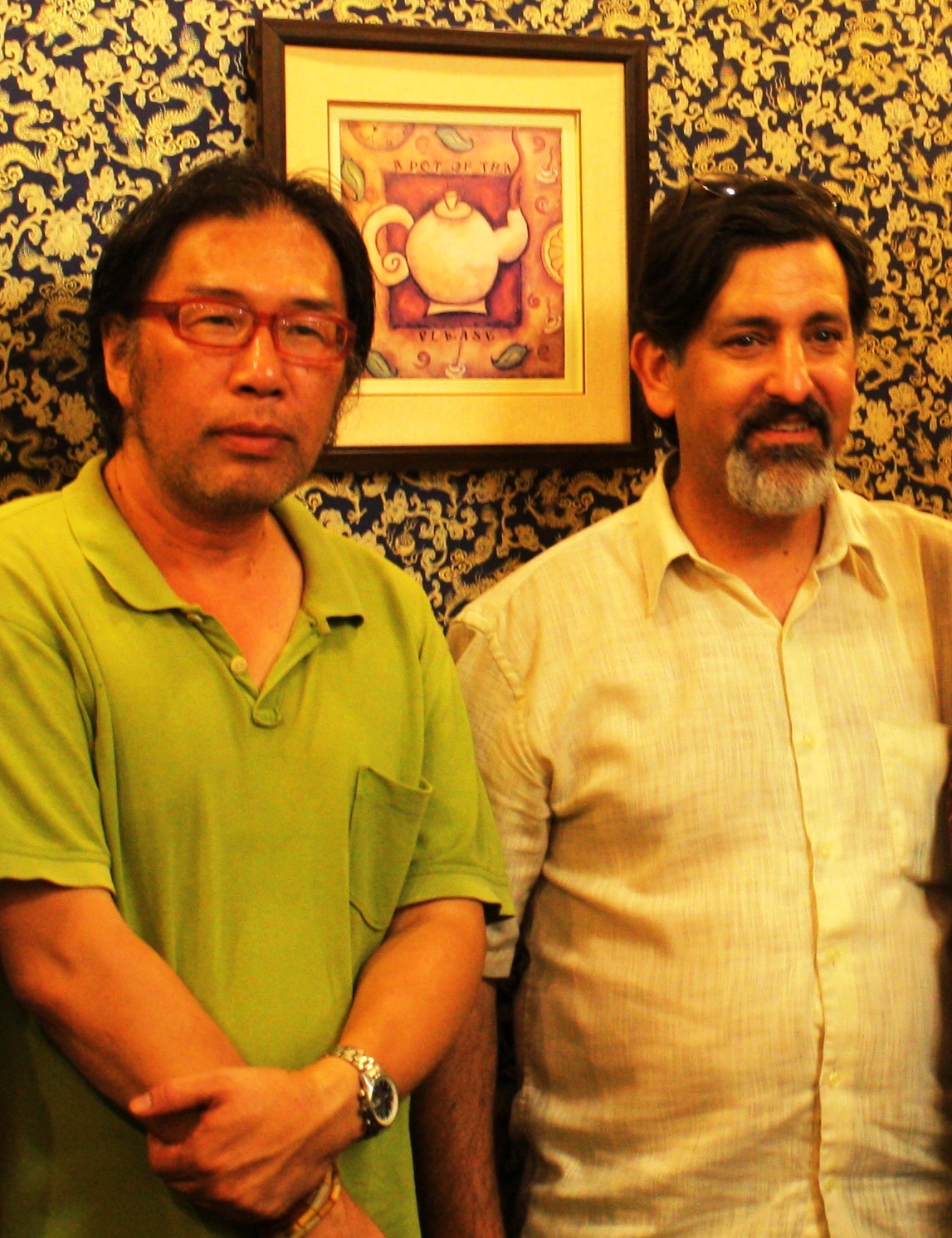
The inimitable Paul Nelson met Xi Chuan when they both attended the Qinghai Lake International Poetry Festival 青海湖国际诗歌节 last August. After Xi Chuan’s Copper Canyon reading in Seattle, Paul met with Xi Chuan for an interview, part one of which has just been posted on splab.org. In English, the interview shows Xi Chuan at all his depth and breadth, ranging from the importance of Western poetries to Chinese literature and the place of Ezra Pound to his difficulties in the face of the personal and social upheavals he of 1989; it also includes a bit of a reading of my translation of Xi Chuan’s prose poem “Beast” 巨兽. Here’s Paul’s write-up.

Xi Chuan, peN

While in China for the 3rd Qinghai Lake International Poetry Festival this past August, I met one of the most renowned younger Chinese poets, Xi Chuan. He has a book coming out next year entitled Notes on the Mosquito, published in translation by New Directions. In Seattle recently to celebrate the release of an anthology of contemporary poetry from China, Push Open the Window (Copper Canyon Press) he talked about the opening in Chinese poetry after the Cultural Revolution. SPLAB Presents for the week of October 17, 2011.

SPLAB Presents airs Thursdays at 4:30 p.m. on KBCS.FM, 91.3, or you can listen to the interview here.